
Compare the inputs behind the two amounts
Take one job and separate labour from materials on the quote. Review who recorded time, what their cost rates were and which items were actually used.
Investigate the difference you can explain
A missing cost rate can make a job appear more profitable than it was. Resolve gaps before changing your price book or the hours allowed for the next similar job.
Find missing cost inputs before trusting the margin
Open the accepted quote and record the labour and material assumptions. In the job, compare Time Tracking and Materials with those assumptions. Check that the recorded costs cover the work, including approved changes.
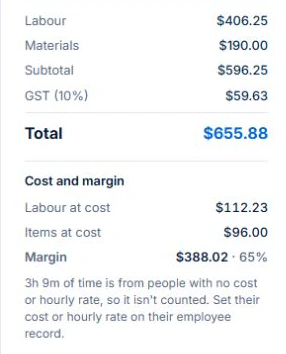
With job-financial access, scroll to the Job Summary card and find Cost and margin. The demo warning flags uncosted labour. Review employee rates and check material unit costs separately, since a missing unit cost contributes zero. Use approved changes to explain differences in scope separately from delivery cost.
Keep the estimate you started with
Record the quantities and assumptions behind the quote, including expected labour and materials. If the quote changes before acceptance, keep the agreed version as the reference point.
Without that starting point, an overrun becomes a general feeling rather than something you can investigate. A job that used more labour may have been under-estimated, delayed by access or expanded by the customer; those lead to different decisions.
Capture direct costs against the correct job
Review time, materials and other relevant direct costs. Check missing records and duplicates before comparing the total with the estimate. Decide how your business treats shared purchases or material returned to stock so the comparison is consistent.
Recorded hours and the rate charged to the customer are different things. Use the costing basis appropriate to your business when reviewing cost, and your customer agreement when reviewing billing.
Use a small example to check the meaning of the number
Suppose an illustrative job has $1,000 of agreed revenue and $650 of recorded direct costs, both excluding GST. The difference is $350, or 35% of revenue. That is a contribution before overheads and other business costs, not a claim of net profit.
If the customer adds $200 of agreed work and the additional direct cost is $120, the revised figures are $1,200 revenue and $770 direct cost. The contribution becomes $430, about 35.8%. The extra revenue should only be included when it belongs to the agreed scope and billing basis you are reviewing.
Turn the review into a better next quote
Look at the reason for the difference. Update an assembly that understates labour, check a stale material cost, or improve how the team records additions. Comparing similar jobs can reveal a repeated issue that one total hides.
Axiom Blue brings job time and materials alongside quotes, variations and billing. Use those records to review your figures. Professional variations keep approved scope changes visible; they do not make missing cost entries complete or turn an invoice into cash received.
Make it useful today
Print or keep a working copy.
Each resource includes a blank worksheet and an illustrative example. Open it to print, or download an HTML copy to keep. No signup needed.
Put it to work
Your practical checklist
- Inspect the accepted quote and its estimated quantities.
- Review job time and materials for omissions.
- Separate approved extras from unagreed requests.
- Check direct contribution separately from overhead and cash.
- Update the estimate for the next similar job.
See the records in Axiom Blue
Try the workflow with a familiar job.
Features and usage limits vary by plan. Review the tools relevant to your process before choosing your setup.