
Look at elapsed time and labour separately
A two-person installation can use more labour hours than the time the team spends on site. Review the individual entries before comparing the job with its duration estimate.
Investigate the overrun before changing the next quote
Use Professional Crew Throughput to find the completed job, then check access delays, return work and scope against the notes. Use a comparable visit when deciding what to allow next time.
Run the completed-job time review in AxiomBlue
Crew Throughput brings estimates and recorded duration into one report. It requires Professional and the relevant report access. Opening or correcting an underlying job also depends on your job permissions.
Use Completed job performance for this review. It selects jobs by completion date, including jobs subsequently invoiced. The separate Scheduled job delivery section uses scheduled dates and answers a different question. The report is business-wide, without an HVAC-unit filter; if you deliver several trades, inspect the relevant jobs rather than treating the company total as HVAC-only.
- Open Reports → Crew Throughput, or use Change Report from another report. Choose From and To for the completed work you want to review, then select Apply dates.
- Read the completed, counted and excluded totals. Compare Estimated, Actual and Over estimate for the counted jobs. Resolve missing records before treating that subset as representative.
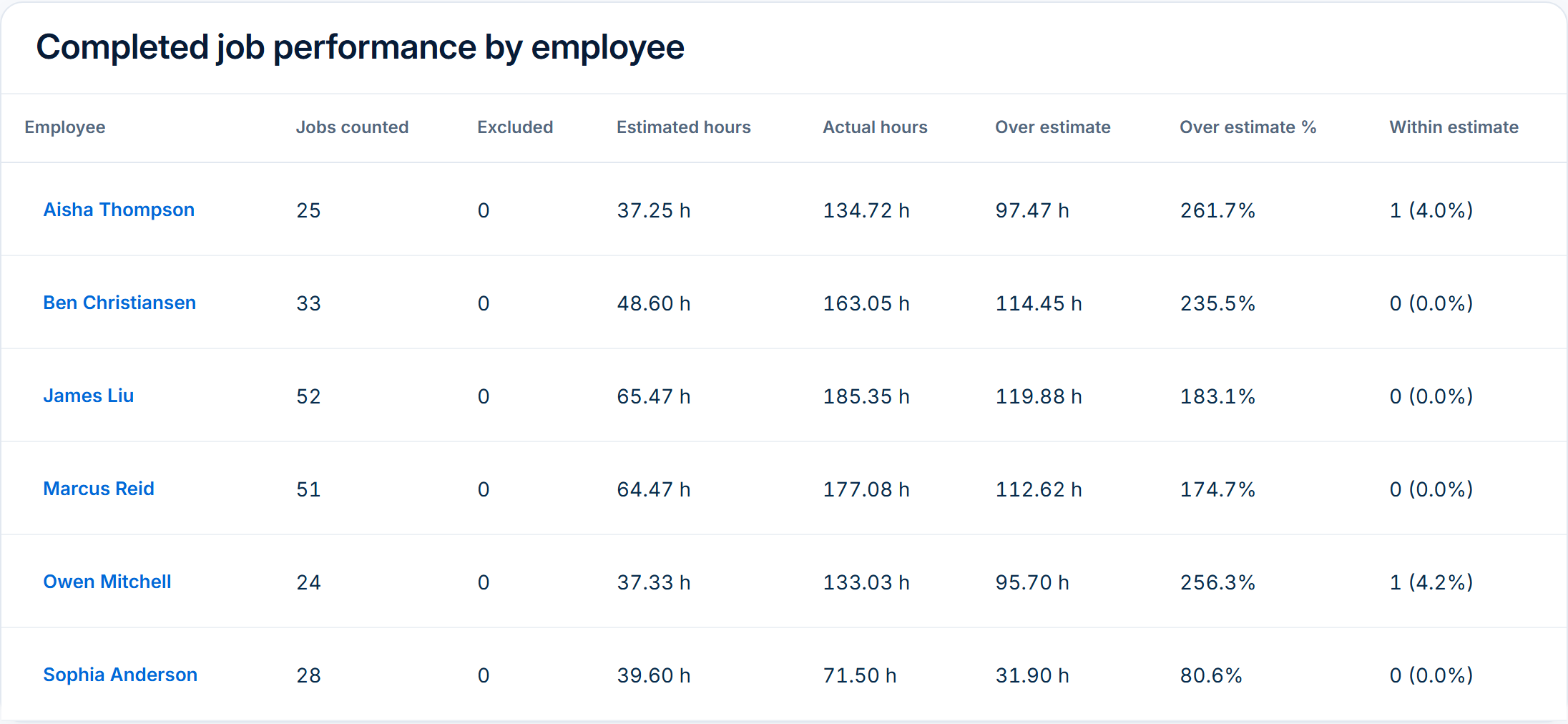
- Review Completed job performance by crew and by employee. Select an employee to open their job breakdown, then follow a job link to inspect its estimate, time entries and scope.
- Check whether the exception concerns a routine maintenance visit, an installation or return work. Keep job references and the reason for any difference so unlike jobs do not silently become one benchmark.
- Review the next comparable job’s Estimated Duration using the checked work and the expected scope. Keep the reason for the new assumption. Changing an estimate remains your decision; this report does not reprice work or update future jobs.
Sources: AxiomBlue Reports and access requirements · Job Details and duration fields
Two technicians can mean four labour hours and 2.5 hours on site
Illustrative example only, not measured customer results: an HVAC maintenance job has an Estimated Duration of two hours. Technician A records 08:00–10:00 and technician B records 08:30–10:30. Assume both entries are closed, with no breaks or other duration adjustments.
Each technician records two hours, giving four person-hours in total. The merged on-site intervals run from 08:00 to 10:30, so the report’s actual job duration is 2.5 hours. The shared 08:30–10:00 interval counts once in that duration.
Against the two-hour estimate, the duration overrun is 0.5 hours, or 25%: (2.5 − 2) ÷ 2 × 100. Both employees can receive the full job result in their breakdown. Adding those rows would duplicate the job, not reveal four or five hours of elapsed site time.
| Measure | Time |
|---|---|
| Estimate | 2.00 h |
| Actual duration | 2.50 h |
| Person-hours | 4.00 h |
| Over estimate | 0.50 h / 25% |
Read next Timesheet software for tradies: hours and approval →
A period total can hide a job that ran over
The report adds the counted jobs’ estimates and actual durations before calculating the period’s Over estimate figure. Faster jobs can offset slower ones. It is not the sum of every positive job overrun.
Continue the illustrative example with a second job estimated at one hour and completed in half an hour. Together, the two jobs have three estimated hours and three actual hours. The period is therefore zero hours over estimate, even though the first job ran 25% over.
Use the employee breakdown to find work within or over estimate, then compare similar service types and access conditions when updating planned durations.
Check exclusions and the completion window before deciding
Open clock-ins and jobs missing valid estimates or duration are excluded from time comparisons, though they can remain in the completed total. Resolve those gaps before using the comparison to update estimates.
Open the job record to resolve missing or incorrect entries with the person who did the work. Keep genuine interruptions and scope changes visible. Correct records because they are wrong, rather than changing history to improve a report result.
A job spanning several days is counted once on its completion day, using its whole recorded job duration. A completion-date report is therefore different from hours worked during the selected dates. Use the relevant time records for a period-based labour review; unfinished installations are not a completed-job result yet.
Sources: Review job time entries
Use the exception to change an assumption, then review the next job
Check the reason before changing the next estimate: was the unit scope different, did access delay the work, was another visit needed, or was the original duration simply too short? Compare work with a similar service scope and team arrangement.
For the next comparable job, review Estimated Duration and retain the assumption behind it. After completion, run the report again for a comparable set of jobs. Values can change when job records are corrected, so keep your review date and job references.
Use duration findings to improve planning, then review employee time, cost rates, materials and agreed revenue for job costing. The linked cost and invoicing guides cover those next steps.
Read next Review job costs in AxiomBlue: quote against actual work → · HVAC invoicing software: from service visit to invoice → · HVAC service scheduling: make maintenance and installations fit →
Common questions
Questions about HVAC job-time reviews
Which plan includes the completed-job report?
Crew Throughput is a Professional report and requires the relevant report access. Job drilldown and edits also depend on job permissions. Core job time recording is a separate capability; this guide’s report workflow is not included in Free or Basic.
Can I add employee rows to get total job hours?
Not for the report’s elapsed duration. Employees can share the full result of a job, while company totals count it once. Use individual time entries for person-hours and labour-cost review; use the merged on-site duration to compare with Estimated Duration.
Why can the total show no overrun when one job ran late?
The period compares total estimated and actual duration for counted jobs. A faster job can offset a slower job. Inspect the job breakdown before deciding which estimating assumption needs changing.
Does this report calculate payroll or change my next quote?
No. It supplies completed-job duration and estimate comparisons. Review payroll inputs, costing and customer prices through their appropriate records and processes. You decide whether and how to change the next estimate.
Put it to work
Your practical checklist
- Confirm Professional report access and the relevant job permissions.
- Choose the completion-date window and record the review date.
- Check completed, counted and excluded jobs before using the time figures.
- Investigate a job through the employee breakdown.
- Keep merged site duration separate from technician person-hours.
- Review job-level exceptions even when the period total is within estimate.
- Change the next comparable assumption only after checking scope and records.
See the records in Axiom Blue
Review the job behind the time result.
Open Crew Throughput, set the dates and review the completed-job summary, then drill into an employee’s jobs. The report requires Professional and appropriate access.
Product instructions
Written by AxiomBlue. The worked examples illustrate job-duration review using Crew Throughput.