Electrical • Test & Tag
How to Never Miss a Test and Tag Retest Date
A missed retest date isn't a testing failure — it's a remembering failure. AxiomBlue removes the remembering: the AS/NZS 3760 register tracks every item's due date, the recurring job series books the retest visit by itself, and the customer gets a text the evening before you arrive.
Quick answerYou never miss a retest date by making software own it twice: a register that tracks each item's AS/NZS 3760 retest interval and due date, and a recurring job series that books the retest visit on the calendar automatically. AxiomBlue, Australian job management software, does both — from $29 AUD per seat per month with a free plan that has no time limit.
Every test and tag business knows the failure mode. The testing itself is fine — the tester works, the technician is competent, the tags go on. What slips is the date twelve months later, held in a spreadsheet nobody reopens and a diary that belongs to one person. AxiomBlue replaces both with a register that watches the calendar and a schedule that fills itself.
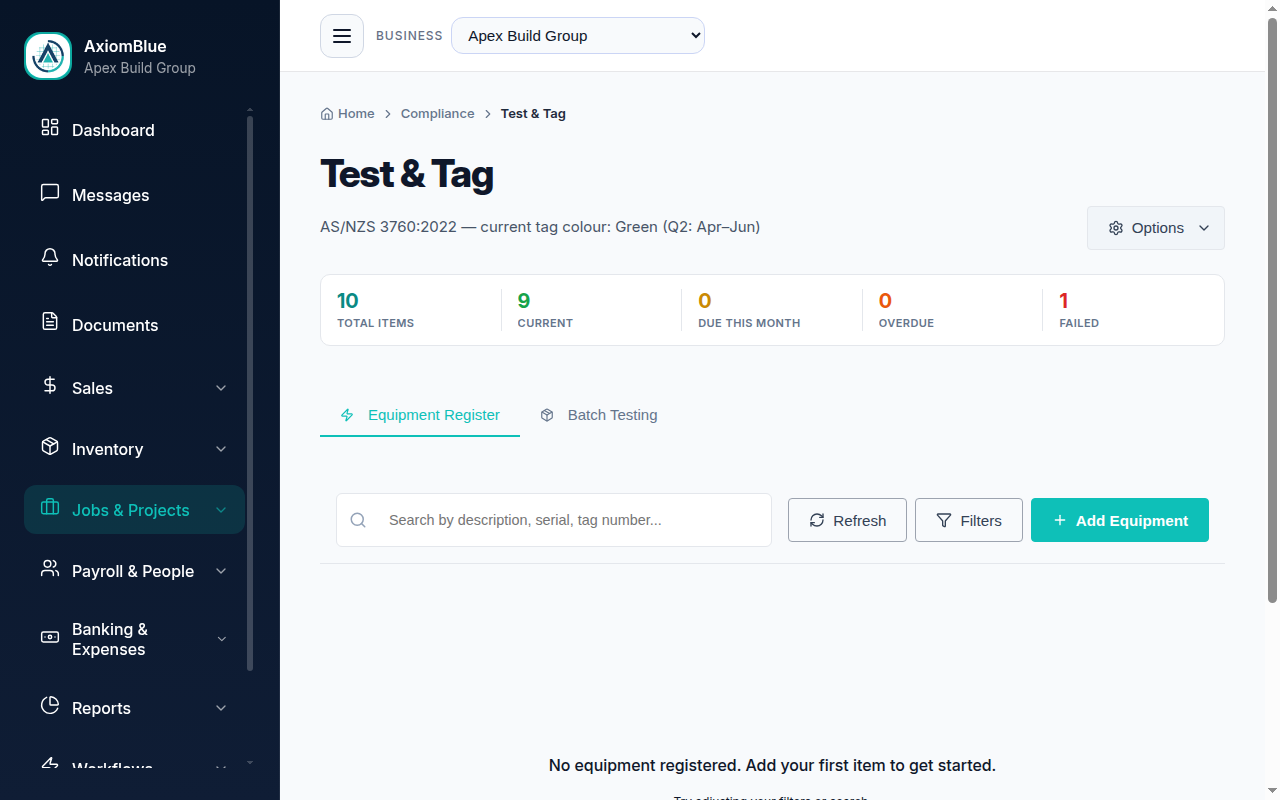
- Every item's retest interval and due date, from AS/NZS 3760:2022 by environment
- Due, overdue and failed items flagged on the dashboard — before the date, not after
- Recurring job series create each retest visit on the schedule automatically
- Evening-before SMS reminds the customer of the booked visit (Professional)
- Work the run from free iPhone and Android apps, or any browser
| Key facts — never missing a retest date with AxiomBlue | |
|---|---|
| The dates | AS/NZS 3760:2022 retest intervals applied by each item's environment |
| The warning | Passed / due / overdue / failed statuses, counted on the dashboard |
| The visits | Recurring job series — each retest visit generates itself on the schedule |
| Customer reminder | Job Tomorrow Reminder — SMS the evening before the visit (Professional) |
| Billing | Invoice the run on site with GST; two-way Xero and MYOB sync |
| Platform | Free native iPhone & Android apps + the full platform in any browser |
| Price | From $29 AUD per seat per month; automation on Professional at $59 |
| Free plan | No time limit, no credit card |
How do you never miss a test and tag retest date?
By taking the date out of human memory and putting it in two systems that check each other: a register that knows when every item is due, and a schedule where the retest visit already exists. In AxiomBlue, recording a test sets the item's next due date from AS/NZS 3760:2022 automatically, the dashboard flags anything approaching or past that date, and a recurring job series books the retest visit on the calendar without anyone raising it. The date is tracked in one place and acted on in another — and neither place is somebody's head.
That two-layer design matters because each layer covers the other's blind spot. A register alone still needs someone to open it, notice the due column, and book the work — which is exactly the step that fails in a busy month. A calendar alone tells you where to be but not why, or what the compliance position is if a visit gets missed. Together they close the loop: the register is the source of truth for what is due, and the series makes sure the visit that satisfies it is already sitting in next month's schedule.
This page is about that workflow. If you're after the register itself — what an AS/NZS 3760 register holds, how environments drive intervals, quarterly tag colours, audit readiness — that lives in the companion guide to test and tag software. Here, we assume the register and answer the operational question: how does a test and tag business make a missed date structurally impossible?
Why do retest dates slip in the first place?
Because the reminder system most businesses use is a person, and the gap between tests is longer than any person's reliable attention span. A six-monthly or yearly interval is precisely the wrong length for memory: too long to stay front-of-mind, too short to survive staff changes, busy seasons, and the client who moved buildings. The spreadsheet doesn't ring you. The tag on the lead only warns the people standing next to it. So the date arrives silently, passes silently, and surfaces months later as an awkward conversation — or an audit finding.
The cost lands twice. For the client, an out-of-test item is a compliance exposure they were paying you to prevent. For your business, a missed retest is missed revenue that was already yours — recurring work that didn't recur because nobody chased it. A test and tag operation with a few hundred client items has hundreds of small deadlines a year; run on memory, some percentage of those simply won't happen, and each one is a client discovering they can't rely on you for the one thing the service promises.
The fix is not trying harder. It is moving the dates into a system whose whole job is watching them — and wiring that system to the schedule so a due date turns into a booked visit without a human relay in between.
How does the register know when every item is due?
It calculates the next due date from the standard the moment you record a test. Each item in AxiomBlue's test and tag register carries its environment, and the AS/NZS 3760:2022 retest interval for that environment — three-monthly on construction sites, six-monthly in workshops, out to five-yearly in protected low-risk settings — is applied automatically. Record today's pass and the register already knows the date that matters next year. No date arithmetic, no typed-in guesses, no interval that quietly stops being right when an item moves environments.
Then the register does the part a spreadsheet never does: it keeps watching. Items move through passed, due, overdue and failed statuses on their own, and the dashboard counts what's due this month and what's already overdue — so the question "what needs booking?" has a live answer every time you look, across every client at once. That rolled-up view is what turns the register from a filing system into an early-warning system: you see next month's due items while they're still next month's, which is exactly when the visits should be going on the calendar.
One honest boundary worth stating plainly: AxiomBlue does not fire off automatic "your retest is due" marketing emails to your clients. The register tells you what's due; turning that into a booked visit is your call — and the next section is how that step books itself too.
How do recurring job series put retests on the calendar automatically?
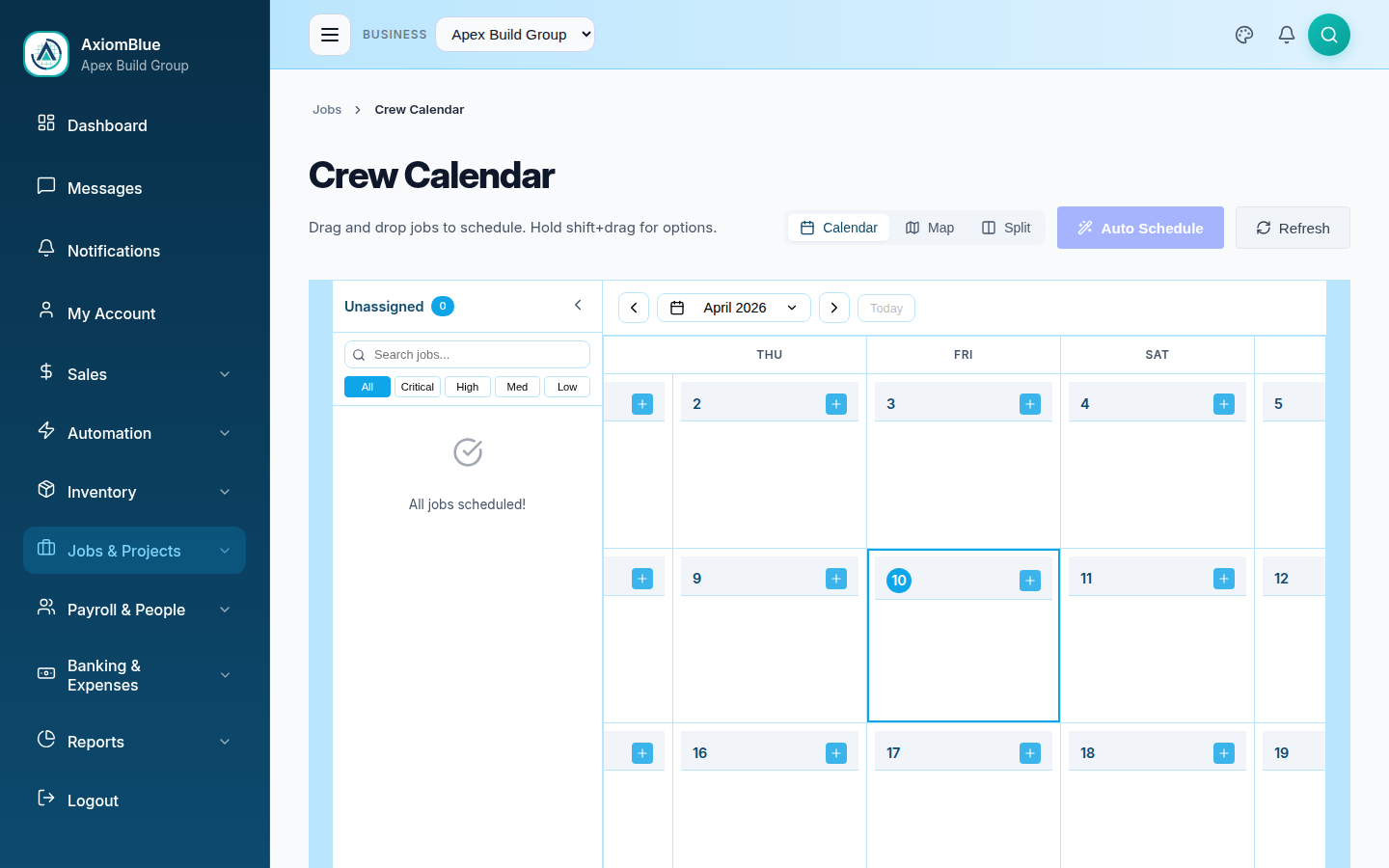
You set the client's testing run up once as a recurring job series, on the cycle their environment demands, and every future visit generates itself. A factory client on a six-monthly cycle becomes a series that produces a scheduled job each six months; a construction client's three-monthly site run regenerates quarterly. Each occurrence arrives on the calendar carrying the customer, the site and the job details from the series — a real, assignable, billable job, created by the schedule rather than by someone remembering.
This is the move that converts compliance dates into work. The register says the workshop's fifty items fall due in March; the series has already put the March visit on the calendar in advance. Your technician sees it in their day's run on the phone like any other job, the office sees it in the week's plan, and when the visit happens, the tests recorded against those items push every due date out another interval — which the next series occurrence will, in turn, arrive to meet. The loop closes and keeps closing.
For the business, the same mechanism is a revenue floor. Recurring testing work is the best kind of work — predictable, repeat, already won — and a series guarantees it actually recurs. No client falls off the run because their reminder lived in a former employee's diary.
Setting up the never-miss workflow, step by step
The whole system is three set-up moves, each done once per client, and then it runs itself:
1. Build the register
Add the client's items with their environments — individually or in batches on the first testing run. From then on, every recorded test sets each item's next due date from AS/NZS 3760:2022 automatically.
2. Create the recurring series
Set the client's testing visit up as a recurring job series on their cycle — three-monthly, six-monthly, yearly. Each occurrence generates itself on the schedule with the customer and site details attached.
3. Switch on the evening-before SMS
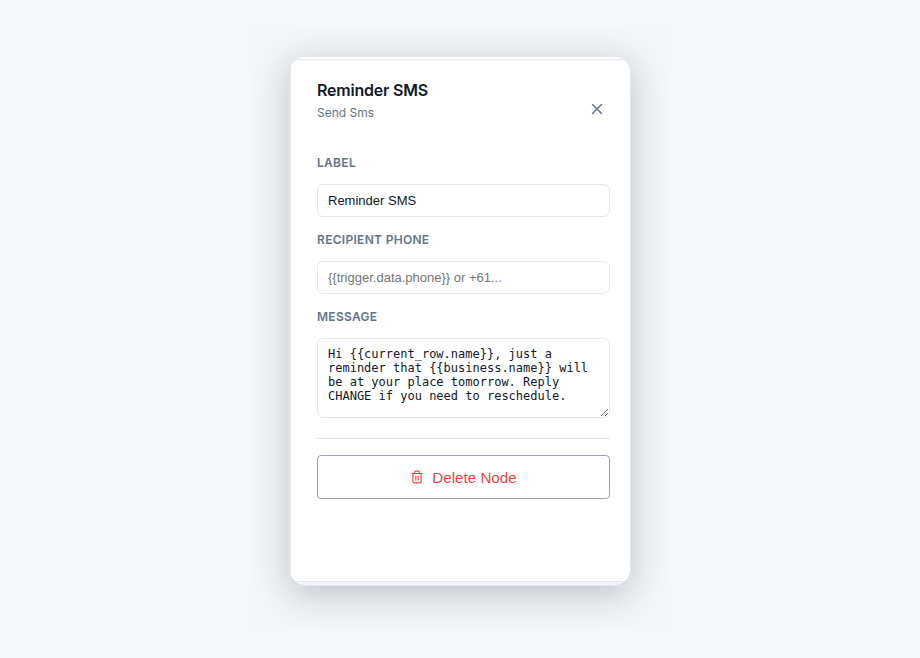
Enable the Job Tomorrow Reminder template (Professional plan) and every customer with a visit booked tomorrow — including series-created retest visits — gets a reminder text the evening before.
After set-up, the ongoing work is just the work: turn up to the visit the schedule created, test the items, record the results on the phone, and invoice before you leave site — with GST handled and a payment link on the invoice. The dashboard's due and overdue counts stay as your safety net over the top, catching anything unusual — the new client not yet on a series, the one-off item added between runs — before it becomes a missed date.
Does the customer get reminded before the retest visit?
Yes — by SMS, the evening before, about the actual booked visit. AxiomBlue's Job Tomorrow Reminder automation template runs on an evening schedule and texts every customer who has a job booked for the next day. Because a series-created retest visit is a normal scheduled job, it's covered automatically: the site manager gets a text tonight that your technician is coming tomorrow, so the gear is accessible, the right person is on site, and the visit doesn't burn an hour on locked doors.
Note what this is and isn't. It is a reminder about a real appointment that already exists in the schedule — not an automated "your retest is due, book now" campaign email. AxiomBlue doesn't send those; the due dates surface to you in the register, and the recurring series means the visit is normally booked long before anyone needed prompting. The customer-facing message is the courteous, concrete one: we're coming tomorrow. The same template, and its companion no-show follow-up, are covered in depth in the SMS job reminders guide.
Like every AxiomBlue automation, the wording is yours — the SMS body is a text box on a visual canvas, editable without code, and every send is recorded in the execution history. Automation templates are part of the Professional plan at $59 AUD per seat per month.
How does this compare with a spreadsheet and a diary?
The honest comparison is with what most test and tag operations actually run on: a register spreadsheet plus somebody's calendar. Both hold the information; neither acts on it. The difference shows up not on the tidy weeks but on the busy ones, when acting on information is exactly what doesn't happen:
| Spreadsheet + diary | AxiomBlue workflow Self-scheduling | |
|---|---|---|
| Next-test dates | Typed by hand, drift over time | ✓ Set from AS/NZS 3760:2022 by environment |
| Warning before a date passes | Only if someone opens the file and looks | ✓ Due and overdue flagged on the dashboard |
| Booking the retest visit | A human relay: notice, remember, book | ✓ Recurring series creates the visit itself |
| Customer knows you're coming | If someone rings ahead | ✓ SMS the evening before (Professional) |
| Survives staff changes | No — the dates leave with the diary | ✓ Register and series belong to the business |
| Billing the run | Separate system, later | ✓ Invoice on site, GST handled, Xero/MYOB sync |
What does the never-miss workflow cost?
The register, the recurring job series, scheduling, on-site invoicing and the free iPhone and Android apps are all included from $29 AUD per seat per month on AxiomBlue's Basic plan — that's the whole date-tracking and visit-booking core. The automation layer, including the evening-before Job Tomorrow Reminder SMS and the rest of the 30+ template library, is part of the Professional plan at $59 AUD per seat per month. There is a free plan with no time limit and no credit card, so you have as long as you need to load a real client's register, set up their series, and watch the first visit appear on the calendar by itself.
Weigh that against what one missed retest costs: a client's compliance exposure, a repeat visit's revenue, and a slice of the reliability that is the entire pitch of a test and tag business. The workflow on this page exists so that number stays at zero — not through discipline, but through design.
Retest Reminders — Common Questions
Stop relying on memory and make the system own the date twice. In AxiomBlue, the AS/NZS 3760 register tracks each item's retest interval and flags what is due or overdue, and a recurring job series books the retest visit on the calendar automatically. The date lives in the register and the visit lives in the schedule - neither depends on anyone remembering.
No - AxiomBlue does not send retest-due marketing emails to customers. The mechanism is different: the register shows you exactly what is due, the recurring job series creates the retest visit in the schedule, and the Job Tomorrow Reminder template can text the customer the evening before that booked visit. The reminder is about a real appointment, not a campaign.
From the standard. AxiomBlue's test and tag register applies the AS/NZS 3760:2022 retest interval for each item's environment - the harsher the environment, the shorter the interval - and sets the next due date the moment a test is recorded. Items then move through passed, due, overdue and failed statuses automatically, and the dashboard counts what is due this month and what is overdue.
Yes. Set a client's testing run up as a recurring job series in AxiomBlue - six-monthly for their workshop, yearly for their office - and each occurrence generates itself on the schedule. The visit exists on the calendar before anyone thinks about it, with the customer, site and job details carried across from the series.
Yes, if you switch on the Job Tomorrow Reminder automation template. It runs on an evening schedule and sends an SMS to every customer with a job booked for the next day - including retest visits created by a recurring series. The customer gets a text the evening before, so the site is expecting you and the gear is accessible. Automation templates are part of AxiomBlue's Professional plan at $59 AUD per seat per month.
Yes. AxiomBlue has free native iPhone and Android apps covering the field workflow - today's schedule, job details, photos and documents to the job record, and on-site invoicing - and the full platform also runs in any web browser, including on a phone. A technician can work the day's testing run from the app and the office sees the same records live.
It depends on the environment, which is what AS/NZS 3760:2022 sets out: intervals range from three-monthly on construction and demolition sites, through six-monthly in factories and workshops, and yearly where leads are prone to damage, out to five-yearly in protected low-risk environments. AxiomBlue applies the interval for each item's environment automatically - always confirm specifics against the current edition of the standard for your situation.
The register, recurring job series, scheduling, invoicing and the mobile apps are included from $29 AUD per seat per month on AxiomBlue's Basic plan. The automation templates - including the evening-before Job Tomorrow Reminder SMS - are part of the Professional plan at $59 AUD per seat per month. There is a free plan with no time limit, and no credit card is required to start.
Make the Missed Retest Impossible
Load one real client into the register, set their series, and watch next cycle's visit appear on the calendar by itself. That's the whole trick — and the free plan gives you as long as you need to see it work.
No credit card required • Free plan, no time limit • Cancel anytime