Test & Tag
Test & Tag Software That Knows When Everything's Due
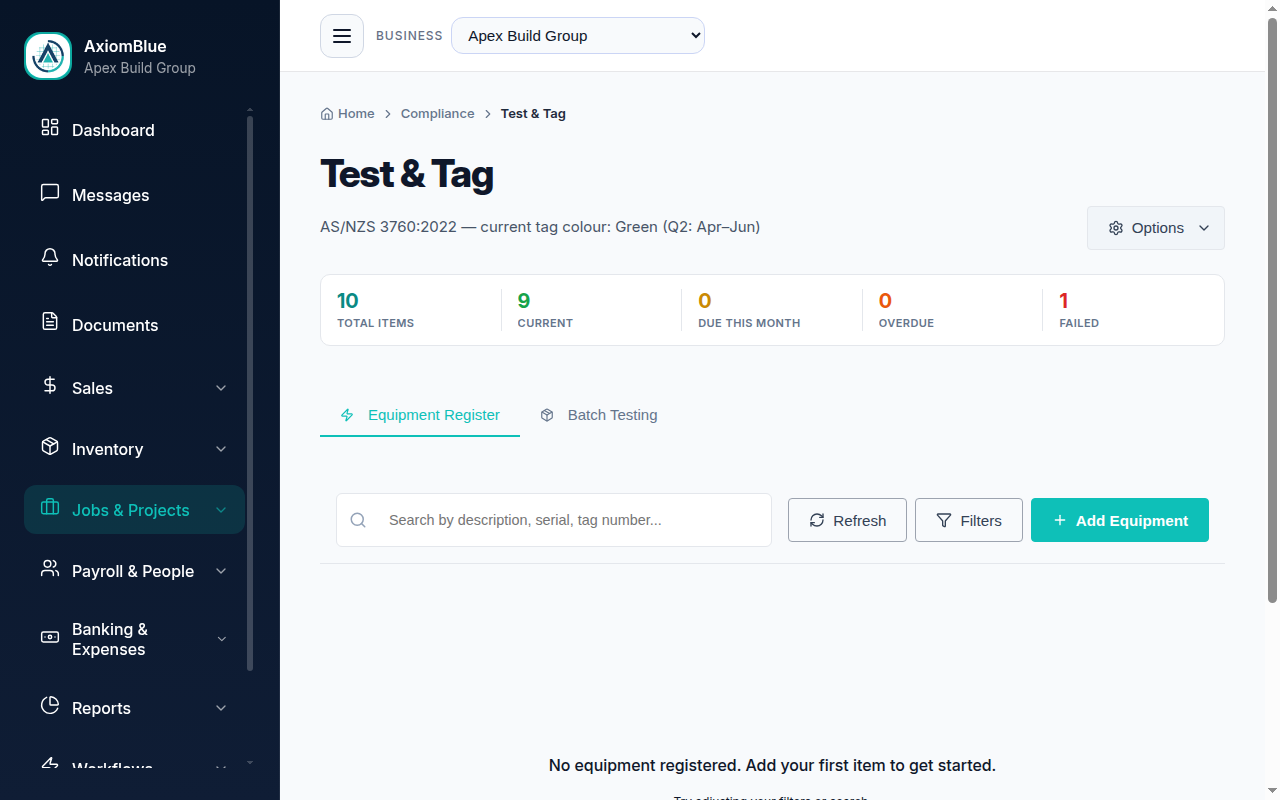
AxiomBlue keeps the register, works out every retest date from AS/NZS 3760:2022 by environment, and flags what's due, overdue or failed. The spreadsheet that always fell out of date, replaced by a system that never does.
Quick answerTest and tag software keeps a register of the equipment you test, records each result, and works out the next test date for you. AxiomBlue applies the AS/NZS 3760:2022 retest intervals based on each item's environment, tracks the quarterly tag colours, and shows what's due, overdue or failed — from $29 AUD per seat per month with a free plan that has no time limit.
The compliance risk with test and tag isn't usually the testing — it's the schedule. An item tested twelve months ago is due now, but the only reminder is a colour on a tag and a line in a spreadsheet nobody's opened. Miss it, and the first you hear is when an auditor or an incident asks for records you can't produce cleanly.
AxiomBlue takes the schedule off your plate. Record a test and it sets the next due date from the standard. Then it watches the calendar for you, so due dates surface before they're overdue — not after.
| Key facts — AxiomBlue test & tag | |
|---|---|
| Standard applied | AS/NZS 3760:2022 retest intervals, set by each item's environment |
| The register | Every appliance, lead and item with environment, history and status |
| Statuses | Passed, due, overdue, failed — flagged automatically |
| Tag colours | Quarterly colours tracked in step with the register |
| Bulk work | Batch testing for site or client runs |
| Billing | Same platform as jobs, quoting and invoicing — test, record, bill |
| Price | From $29 AUD per seat per month |
| Free plan | No time limit, no credit card — native iPhone & Android apps + the full platform in any browser |
What is test and tag software?
Test and tag software is a compliance register with a clock: it holds every appliance, lead and item you're responsible for testing, records each test's result, and calculates when the next test falls due under AS/NZS 3760 — then keeps watching those dates so you don't have to. The "test" half is your tester and your competence; the software owns the half that fails in practice, which is the remembering.
AxiomBlue's test and tag register is part of a full job management platform built in Australia, which changes what the register can do: the client you test for is the same client you schedule, job-manage and invoice, so a testing run is a job like any other — booked on the calendar, worked from a phone on site (free iPhone and Android apps, or any browser), and billed the day it's done. For a test-and-tag business, the register isn't a standalone compliance silo; it's wired into how the work gets sold and paid for.
How does the register keep you compliant?
It keeps you compliant by turning every recorded test into a scheduled next date, automatically, and then flagging anything that approaches or passes it. The work was never recording one test — it's remembering the hundred next ones, and that's precisely the part AxiomBlue does:
Everything in One Register
Each item lives in the register with its environment, last test, result and status. Add items individually or test them in batches.
Dates from the Standard
Record a test and AxiomBlue sets the next due date using the AS/NZS 3760:2022 interval for that item's environment. No manual date maths.
Nothing Slips
Items move through passed, due, overdue and failed automatically, and the dashboard counts what's due this month, overdue and failed.
How often does equipment need testing under AS/NZS 3760:2022?
The interval depends on the environment the equipment lives in — the harsher the environment, the shorter the interval. That's the core logic of AS/NZS 3760:2022: intervals range from three-monthly on construction and demolition sites, through six-monthly in factories and workshops, and yearly where leads are prone to flexing and damage, out to five-yearly in protected, low-risk environments. One workshop grinder and one office monitor can sit metres apart with schedules years apart.
That environment-driven variety is exactly why spreadsheets fail at this job. A register where every row carries its own interval, and where the interval must change when the item moves environments, is a database problem wearing a spreadsheet costume. AxiomBlue stores the environment against each item and derives the next-test date from it, so the schedule is a consequence of the data rather than a separate thing someone maintains — and when an item's environment changes, its future dates change with it.
The usual caveat applies and belongs on any honest page about the standard: AS/NZS 3760:2022 is the reference, editions and site rules evolve, and specific obligations should be confirmed against the current edition for your situation. What the software guarantees is that whatever interval applies to an item is applied consistently, every time, without anyone doing date arithmetic in their head.
How do the quarterly tag colours work?
The tag colour is the physical half of the system: a colour that changes each test period, so anyone on site can see at a glance whether an item was tested in the current period without reading a date in the rain. On construction sites, AS/NZS 3012 conventions rotate the colours quarterly, and an out-of-colour tag is the first thing a site inspector's eye lands on.
The register is the other half, and the two have to agree. A tag says "tested this period"; the register says by whom, with what result, and when the next test is due — and if tag and register drift apart, you've got the worst of both worlds: equipment that looks compliant and records that can't back it up. AxiomBlue tracks the tag colours per period in step with the register, so the colour on the lead and the line in the system tell the same story. When the auditor works from the tags inward, everything they pull matches.
Why does the spreadsheet register always fall behind?
Because a spreadsheet has no clock and no opinion — it records what someone types and goes silent. A test and tag spreadsheet starts tidy and ends as a liability: intervals typed wrong or never updated when an environment changes, a "due" column that only warns if someone re-sorts it and actually looks, and history scattered across tabs when an audit wants it in one place. A purpose-built register removes the two things that go wrong — the date maths and the remembering:
| Spreadsheet register | AxiomBlue test & tagAudit-ready | |
|---|---|---|
| Next-test dates | Typed by hand, often wrong | ✓ From AS/NZS 3760 by environment |
| What's due or overdue | Only if someone re-sorts and looks | ✓ Flagged automatically |
| Pass / fail history | Scattered across tabs | ✓ Held against each item |
| Quarterly tag colours | Remembered, maybe | ✓ Tracked |
| Environment changes | Someone edits every affected row | ✓ Update the item; dates follow |
| Audit readiness | A stressful scroll | ✓ Records to hand |
What's included in AxiomBlue's test & tag software?
The register, the scheduling, the statuses, and the billing side — because compliance sits inside the same platform as jobs and invoices, an electrician tests clients and bills them in one system:
Equipment Register
Every item with its environment, location, last test and status — the single source of truth for what you're responsible for.
AS/NZS 3760:2022 Intervals
Retest periods applied from the current standard by environment, so the schedule is right without you looking it up.
Due / Overdue / Failed KPIs
A dashboard that counts what's due this month, what's overdue, and what's failed — the whole compliance picture at a glance.
Quarterly Tag Colours
The standard tag colours tracked per period, so physical tags and the register stay in step.
Batch Testing
Record a run of items together for a site or a client, without adding them one at a time.
Testing Meets Billing
Because it's part of AxiomBlue, a client's testing sits next to their jobs and invoices — test, record, and bill in one place.
Who is test and tag software for?
Two groups, with different stakes in the same register. The first is electricians and test-and-tag businesses who test for clients: for them the register is the product — the thing that proves the service, schedules the repeat visits, and generates the next round of work when a client's items come due. Recurring testing runs can be scheduled like any other recurring work, and the invoice for a testing job goes out through the same platform, from site if you like, the day the run is done.
The second group is any trade or business keeping its own tools and gear compliant — the builder whose leads and saws work construction sites on a three-month cycle, the workshop with a wall of power tools, the cleaning company with equipment in client buildings. For them the register is insurance in the literal sense: when an incident or an insurer asks whether that lead was in test, the answer is a record, not a shrug. Same register, same statuses, no testing business required.
What does an audit actually ask for?
Records — complete, current, and producible on the spot. Test and tag is one of those obligations that's invisible right up until it isn't: ninety-nine days out of a hundred, nobody asks. On the hundredth — an audit, an insurance query, an incident — the question is whether every item's history is in one place and every due date was honoured, and the honest answer with a spreadsheet is often "let me check." That pause is the risk.
A register that schedules itself removes the pause. Every item's history is held against the item, every due date came from the standard, and anything overdue was flagged before it got there — so the answer to "show me" is a screen, not a search. For an electrician it also turns compliance into a service you can offer clients with a straight face, because your own house is provably in order.
Test & Tag — Common Questions
Test and tag software keeps a register of the electrical equipment you test, records each test's result, and works out when the next test is due. AxiomBlue calculates retest intervals from AS/NZS 3760:2022 based on each item's environment, so the schedule follows the standard automatically instead of living in a spreadsheet.
Yes. AxiomBlue applies the AS/NZS 3760:2022 retest intervals and sets each item's next-test date from its environment — the harsher the environment, the shorter the interval. When you record a test, the next due date is calculated for you.
It depends on the environment, which is exactly what AS/NZS 3760:2022 sets out. Intervals range from three-monthly on construction and demolition sites, through six-monthly in factories and workshops, and yearly where leads are prone to damage, out to five-yearly in protected, low-risk environments. AxiomBlue applies the interval for each item's environment automatically — always confirm specifics against the current edition of the standard for your situation.
Yes. The dashboard shows how many items are due this month, how many are overdue, and how many have failed. Every item carries a clear status — passed, due, overdue or failed — so nothing quietly slips past its date.
Yes. AxiomBlue tracks the standard quarterly tag colours, so you can tell at a glance which items were tested in which period and keep the physical tags consistent with the register. On construction sites, where AS/NZS 3012 conventions make the current colour a visual pass at a glance, that consistency is what an inspector checks first.
No. It suits electricians and test-and-tag businesses who test for clients, and any trade or business that has to keep its own tools and equipment compliant. Because it's part of AxiomBlue, testing can sit alongside the jobs, invoicing and scheduling for the same customers.
AxiomBlue starts at $29 AUD per seat per month, with compliance tools included alongside job management, quoting and invoicing. There is a free plan with no time limit, and no credit card is required to start. See the pricing page for plan details.
Retire the Test & Tag Spreadsheet
Let the register schedule itself from the standard and flag what's due. Start free and be audit-ready without the admin.
No credit card required • Free plan, no time limit • Cancel anytime