
Key facts
| Minimum to start | An ABN, insurance appropriate to your work, your state and council licences, equipment you can already access, and a way to quote and invoice. |
|---|---|
| ABN | Free to apply for through the Business Registration Service. A sole trader carrying on an enterprise is entitled to one. |
| GST registration | Compulsory once your GST turnover reaches $75,000, and within 21 days of becoming aware you will pass it. A new business expecting to reach $75,000 in its first year should register. |
| Licences and permits | Vary by business type, activity, state or territory and local council. ABLIS lists what applies to you. |
| Insurance | Check workers compensation obligations with your state or territory authority if you employ people. Review liability, equipment and vehicle risks with an insurer or broker for your own activities. |
| Software to start | Axiom Blue free plan: no time limit, no credit card, one user, 10 jobs a week, 10 quotes and 10 invoices a month, 25 customers, 25 leads. |
| Software as you grow | $29 AUD for the first seat per month, excluding GST (Basic) or $59 (Professional). No job caps, no per-job fees, no setup fee, no lock-in. |
| Where it runs | Native iPhone and Android apps and any web browser, so the whole business fits in the phone already in your pocket. |
Set up the first landscaping quote and job in AxiomBlue
- Set your business and tax details, then add the first customer and property. In Products & Services, enter the labour, plants and materials you repeatedly price; use actual supplier costs and your own charging basis.
- Create a quote for a sample garden refresh with separate preparation, planting and disposal lines. Check the site assumptions, terms and customer-facing total. Convert accepted work to a job and put the visit scope, duration and address on it.
- Record actual labour and used materials on the job, then compare them with your estimate and review the invoice. Add a Professional Job Series only after the customer agrees the repeat service. Keep the registration, licence and startup-budget checks below as prerequisites outside the platform.
Build a startup budget before taking the first booking
List what you already own, what must be bought before the first job and what the business must pay while waiting for customers to pay. A smaller equipment list can reduce the initial outlay; it does not remove the need for working money. Obtain quotes for your own activities rather than using a generic startup total.
| Budget item | What to check before committing |
|---|---|
| Equipment and transport | Condition, suitability, servicing and replacement; distinguish equipment you own from purchases you still need. |
| Licences and insurance | Check the activities and location in ABLIS. Compare insurer quotes for the same work, limits, excess and exclusions. |
| Working costs | Allow for fuel, materials, wages where applicable, insurance instalments and the wait between buying supplies and getting paid. |
| First job price | Include the time spent travelling, preparing and cleaning up, then review actual cost after the job. |
Sources: business.gov.au: startup costs · business.gov.au: business insurance · ABLIS licence and permit finder
What do you actually need to start?
Start with the services you can deliver safely and legally. Check the equipment, transport, insurance and licences those services require, then set up a way to quote, schedule, record and invoice the work. Use a real first-job budget instead of assuming every new landscaping business has the same costs.
You may be able to begin with equipment and a vehicle you already own. Check their condition and operating costs before relying on them. Keep money available for supplies, insurance and other bills that fall due before your first customers pay; buy additional equipment when the work and the budget justify it.
- An ABN, and GST registration when you reach the threshold.
- Insurance appropriate to your work. Get advice on what applies to you.
- Any licence or permit your state, territory or council requires.
- Equipment adequate for the jobs you are quoting.
- A way to quote, schedule, record and invoice from your phone, on the job.
Do you need a licence, an ABN or GST registration?
You need an ABN. Applying is free through the government Business Registration Service, and an individual carrying on an enterprise as a sole trader is entitled to one. Apply before you quote your first job, because your ABN belongs on the quote and the invoice.
GST is a threshold, not a choice, once you reach it. Registration is compulsory when your GST turnover reaches $75,000, and you must register within 21 days of becoming aware you will go over it. If you are starting out and expect to reach $75,000 in your first year, business.gov.au advises registering up front. You need your ABN before you can register for GST. Below the threshold you may register voluntarily, but doing so brings the obligations with it: GST in your prices, and activity statements to lodge. That is worth a conversation with your accountant instead of a guess.
Licensing is the part that really varies. What you need depends on your business type, the activities you perform, your state or territory and your local government area. Mowing and garden maintenance often sit outside trade licensing, while structural landscaping, retaining walls, paving, irrigation and anything involving water, electricity or excavation frequently do not. Use ABLIS, the government licence finder, to check your specific activities in your specific area instead of relying on what someone in another state told you.
Insurance follows the same pattern. Workers compensation is compulsory as soon as you employ anyone, and the rules differ in every state and territory. Public liability is required for certain occupations in some jurisdictions and expected by most commercial clients and councils regardless. Get advice on your situation before you are on someone’s property with a machine.
Sources: Business Registration Service (ABN) · Register for GST (business.gov.au) · Licences and permits (ABLIS) · Business insurance (business.gov.au)
Should you start with mowing rounds or landscaping projects?
These are two different businesses that share a ute, and most people who succeed end up running both deliberately, not by accident. Knowing which one you are building this year changes what you buy, who you market to and how your money arrives.
A maintenance round (mowing, edging, hedges, garden tidies on a repeating cycle) is lower value per visit and far more predictable. The work repeats without being re-sold, the cash flow is even, and you can build it while still working another job because the visits are short and schedulable. The risk is that a round is easy to start and easy to lose: it is won and kept on reliability, not on skill.
Landscaping projects, meaning garden builds, paving, retaining, planting and irrigation, are higher value, more satisfying and far lumpier. Each one has to be quoted and won individually, materials have to be bought before you are paid, and one delayed job can empty a fortnight. Project work also runs into licensing sooner, because structural and water-related work is where the rules bite.
The practical answer for most people starting out is a round that pays the bills and covers the fixed costs, plus quoted project work layered on top as it comes. That way the mortgage is covered by the predictable work while the project work builds the reputation and the margin. Decide which side is which, though, and price them differently. They are not the same job with different hours.
How do you price the work so year two is possible?
Most new landscaping and lawn care businesses do not fail because the work dried up. They fail because every job was priced from what the last bloke charged, and the number never covered what the business costs to run.
Work backwards from your own numbers instead. Start with what you need the business to earn in a week before tax. Add what it costs to run: fuel, servicing, blades and consumables, insurance, phone, replacing equipment as it wears out. Then divide by the hours you can truly bill in a week, which is not the hours you work. Travel, quoting, invoicing, tip runs and the ute breaking down all come out of it first.
As an illustration, not a recommended rate: if you need $1,500 a week before tax and the business costs $400 a week to run, that is $1,900. If you can realistically bill 25 hours in a 45-hour week, you need $76 an hour, plus GST once you are registered. On that basis a 45-minute mow is around $57 before travel. And travel is why a tight round in one suburb makes money that a scattered one does not.
Then price the two kinds of work differently. Maintenance visits work as a per-visit price the customer can predict, built from your hourly number and the time the site takes. Project work is quoted from labour plus materials plus a margin on the materials, because the buying, collecting and carting is work you are otherwise doing for free. Write down what the price includes, because the argument you avoid is worth more than the hour you saved.
Read next Lawn-care invoicing: per visit, monthly billing and extra work →
How do you get your first ten customers?
The first ten come from where you already are, not from advertising. Tell everyone you know what you are doing, and be specific about the work you want. Do a visibly good job on a street and knock on the two neighbours either side while your trailer is still there and the lawn still looks sharp. Join the local community groups and answer the requests that appear in them. Leave a card with every customer for the friend who asks who does their yard.
Then win on speed. Most enquiries in this trade are decided by whoever replies first with a real price. Homeowners ring three businesses; two never call back and one quotes next week. If you can look at a job, send a proper quote from your phone before you have left the kerb, and confirm the booking the same day, you will beat better-equipped competitors regularly. That is not a slogan: it is the single biggest advantage a one-person business has over an established one, and it costs nothing.
Make the quote itself do some of the work. A branded quote with your business name, your ABN and GST handled correctly, that the customer opens as a link in their browser and accepts with a tap, tells them you are a real business before you have said a word about experience. In Axiom Blue that quote is built from your saved prices, sent from the phone, and becomes the job the moment they accept it, so nothing gets typed twice.
Read next From website enquiry to booked job: a practical process for tradies →
How do you look established from the very first job?
Customers cannot judge your horticulture. They judge the things they can see: whether you turned up when you said, whether the quote was clear, whether the invoice looked professional, and whether anything had to be chased. Those are all admin, and admin is the cheapest place for a new business to look far bigger than it is.
So get the paperwork right from job one. Quotes and invoices carrying your logo, your ABN and GST calculated automatically. An invoice sent from the driveway, not on Sunday night, with an online payment link so the customer can pay it while you are packing up. A record of what was agreed, so the job three weeks later starts from fact instead of memory.
This matters commercially, not just cosmetically. Strata managers, real estate agents and councils, the customers who bring regular volume, will ask for an ABN, insurance details and a proper tax invoice before they will use you. A business already doing those things says yes to that work; a business running on text messages has to go away and build it first.
Read next On-site invoicing: invoice on the job →
How do you turn one-off jobs into a round?
The difference between a job and a business is repetition. One tidy-up is income; the same garden every fortnight for two years is an asset, and it is the thing that makes the quiet weeks survivable.
Convert deliberately. At the end of any one-off job, offer the maintenance cycle that suits the site, agree what each visit includes, and put the next twelve visits in the calendar, not a promise to call. In Axiom Blue that is a recurring job series: the visits regenerate on the schedule you set, each one carrying the site details, and you review the upcoming ones instead of rebuilding them.
Bill the round in a way that matches how you want money to arrive, either per visit or as a regular monthly amount covering an agreed set of visits. Be precise about what happens when a visit is skipped for weather or a customer goes away. That conversation, had once at the start, prevents most of the invoice disputes in this trade.
Read next Lawn care scheduling software: manage repeat visits → · Recurring jobs versus recurring invoices: keep visits and billing aligned →
What records will you wish you had kept?
Three kinds, and all of them are easy to keep from the start and painful to reconstruct later.
Site records: gate codes, where the tap is, the dog, which strip of grass belongs to the neighbour, what the customer is fussy about. Hold these against the property, not in your head, because the day you put someone else on that round is the day the business stops depending entirely on you.
Keep the agreed scope, changes, time and useful before-and-after photos with the job. These records can help explain the work and review its costs, but do not guarantee a dispute will be resolved. In Axiom Blue, photo uploads start on Basic; recorded time can be compared with the job estimate.
Money records: every invoice, payment, receipt and expense, in one place from day one. The GST threshold arrives faster than most people expect, and recreating a year of it in July costs a weekend and an accountant’s hours.
Read next Landscaping CRM software for clients and sites → · Review job costs in AxiomBlue: quote against actual work →
What software do you need on day one, and what should it cost?
Test the quote-to-invoice workflow on one real job. Axiom Blue has a limited free plan with one user, 10 jobs a week, 10 quotes and 10 invoices a month, 25 customers and 25 leads. Check those limits against your expected workload. The iPhone and Android apps and web portal provide different access options; invoices need a connection and GST treatment follows your registration and taxable lines.
Basic is $29 AUD for the first seat monthly, excluding GST, with no job cap and photo uploads. Professional is $59 and adds managed crews, skills, leave, recurring series, workflows and accounting connectors. Compare the cost for your users and the features you actually need; do not assume every vendor has the same limits or charges.
The depth is there when you need it, which is the other half of the promise. Professional at $59 for the first seat monthly, excluding GST, adds projects, on-site variations with customer approval, custom fields, Dispatch Map with route optimisation that proposes a better order for the day’s run, and more than thirty automation templates. You are not choosing a starter product you will have to leave; you are starting at the bottom of one that goes further than a landscaping business usually needs.
The honest limits, so you know them now: Axiom Blue does not lodge your BAS, run payroll or STP, produce a P&L, or connect to a bank feed and reconcile your statements for you. It syncs two ways with Xero and with MYOB, and your accountant still does those. Your data is hosted in Australia, on Google Cloud in Sydney.
Read next How to choose job management software in Australia →
Start the business today, not when you feel ready
The gap between thinking about this and doing it is usually one afternoon of admin. Apply for the ABN. Find out what your council and state require for the work you intend to do. Sort the insurance. Work out your hourly number from your own costs, not someone else’s price list. Set up the free plan, put your prices in it, and send your first quote from your phone.
None of that requires money you do not have, and all of it can be done before the equipment is paid off, before the ute is signage’d, and before you feel like the kind of person who owns a business. The first customer will not ask how long you have been going. They will ask what it costs and when you can start.
Axiom Blue is free to start, $29 for the first seat monthly, excluding GST when you grow, and there is nothing to cancel if you change your mind. A phone, a car and a mower is a real business. Go and quote something.
Common questions
Questions people ask before they switch
How much does it cost to start a landscaping or lawn mowing business in Australia?
The cost depends on the services, location and equipment you already own. Build a budget for equipment and transport, licences, insurance and working costs before quoting. Obtain current supplier and insurer quotes for your own work. Axiom Blue has a limited free plan for testing the quoting, scheduling and invoicing process; business operating costs still need funding.
Do I need a licence to start a landscaping business in Australia?
It depends on the work and where you do it. Licence requirements vary by business type, activity, state or territory and local government area. Mowing and garden maintenance often sit outside trade licensing, while structural landscaping, retaining walls, paving, irrigation and work involving water, electricity or excavation frequently require a licence. Check your specific activities in your area using ABLIS, the government licence and permit finder, before you quote.
Do I need an ABN to mow lawns?
Yes, if you are carrying on an enterprise, not doing occasional favours. Applying for an ABN is free through the government Business Registration Service, and an individual operating as a sole trader is entitled to one. Apply before your first quote, because your ABN belongs on your quotes and invoices, and you need it before you can register for GST.
When do I have to register for GST as a landscaper?
GST registration is compulsory once your GST turnover reaches $75,000, and you must register within 21 days of becoming aware you will pass that threshold. If you are starting a new business and expect to reach $75,000 in the first year, business.gov.au advises registering from the outset. You need an ABN first. Below the threshold registration is optional, but it brings GST obligations with it, so ask your accountant.
How do I price lawn mowing and landscaping jobs?
Work backwards from your own costs instead of copying a competitor. Add what you need to earn each week to what the business costs to run: fuel, servicing, consumables, insurance, phone and equipment replacement. Then divide by the hours you can bill, which is far fewer than the hours you work. That gives your hourly number. Price maintenance visits per visit from that number, and quote project work as labour plus materials plus a margin.
How do I get my first landscaping customers?
Start with people and local areas you already know, explain the services you can deliver and ask satisfied customers for referrals. Respond with a clear scope and price, then record the next action. Fast quoting can help the customer decide, but it does not guarantee you will win the job. Check GST registration before adding GST.
What software do I need to start a lawn care business?
One thing that quotes, schedules, records the work and invoices it from your phone. Axiom Blue’s free plan covers that with no time limit and no credit card: one user, 10 jobs a week, 10 quotes and 10 invoices a month, 25 customers, with your logo and GST on every document and apps for iPhone and Android. It moves to $29 for the first seat per month, excluding GST when the work outgrows it, with no job caps and no setup fee.
Is mowing maintenance or landscaping projects more profitable?
They are profitable in different ways. A maintenance round is lower value per visit but repeats without being re-sold, which makes cash flow predictable and lets you build while still working elsewhere. Project work is higher value and higher margin but lumpy, with materials paid for before you are, and it runs into licensing sooner. Most successful operators run a round that covers fixed costs plus quoted projects on top.
How much is landscaping business insurance?
The premium depends on the work, business size, people, equipment and cover requested. Describe the same activities to each insurer or broker and compare the insured amount, excess, exclusions and any subcontractor conditions. Include the quoted cost in your budget; a generic industry price cannot establish what your business needs.
Put it to work
Your practical checklist
- Apply for your ABN through the Business Registration Service before you quote anything.
- Check ABLIS for the licences your activities need in your state and council area, and sort your insurance.
- Work out your hourly number from your own weekly costs and realistic billable hours.
- Set up the Axiom Blue free plan, load your prices, and send your first quote from your phone.
- Convert every one-off job into a recurring visit before you leave the site.
See the records in Axiom Blue
Try the workflow with a familiar job.
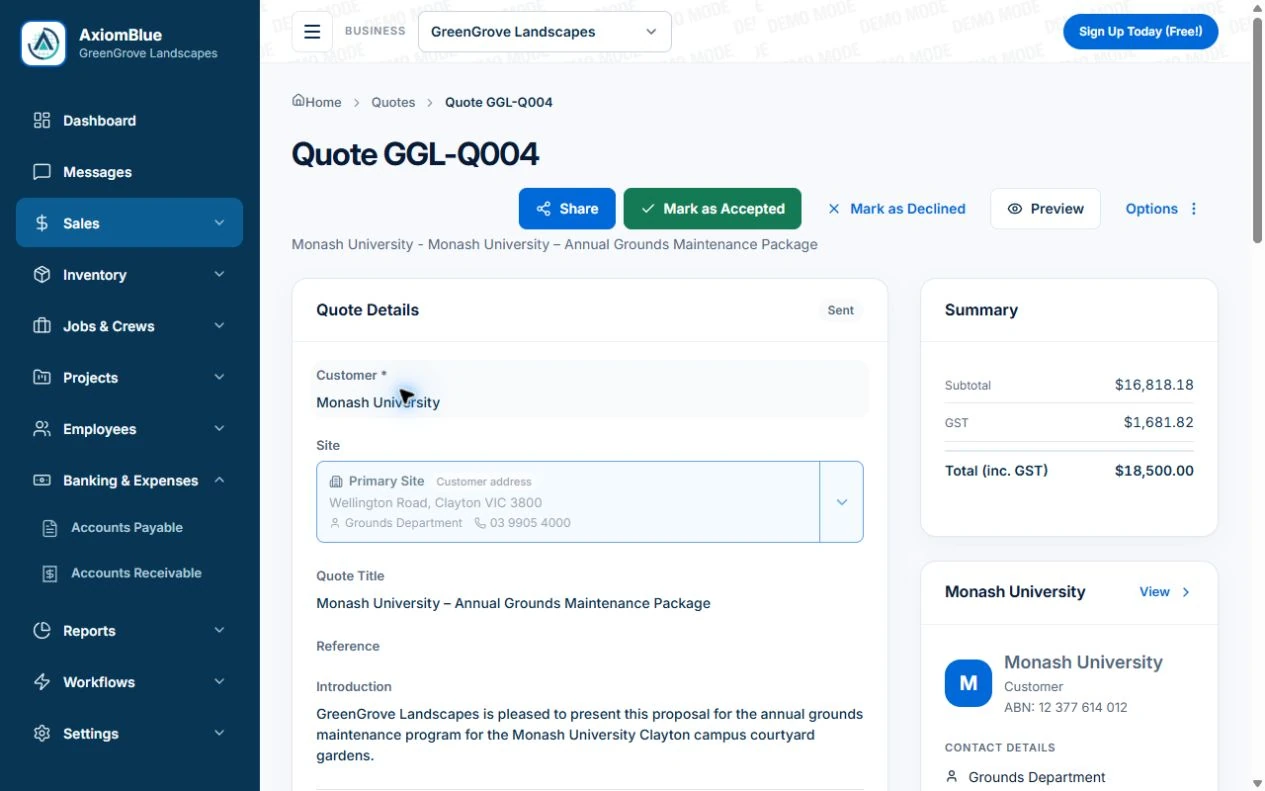
Features and usage limits vary by plan. Review the tools relevant to your process before choosing your setup.
Product instructions
General information only, current as at 22 September 2026. This is not legal, tax, insurance or financial advice, and registration and licensing requirements change. Confirm what applies to you with the official sources linked in each section, your state or territory regulator, your local council and your accountant. Pricing examples are illustrative, not recommended rates.