
The starting point
Plan the work and the billing as two related schedules. Review actual visits against the charging agreement, especially when work is skipped, rescheduled or changed.
Write down the two schedules
The work schedule says when a visit should happen and what needs doing. The billing schedule says when a charge is prepared under the agreement. They can align, but one does not automatically prove the other.
A per-visit service might be invoiced after completion. A fixed periodic service charge follows the agreed terms. A monthly bill collecting several completed visits is another arrangement. Decide which one the customer has accepted before setting up recurrence.
Use a simple timeline to check the arrangement
Illustrative example: a property is serviced on the first and third Tuesday, with completed visits reviewed for billing at month end. Each Tuesday needs its own work record. At month end, review those records and the agreed price before preparing the invoice.
If the third-Tuesday visit moves into the next month, its planned date alone does not tell you which invoice should contain it. Review the actual service date and the billing agreement. Keep the reason for any adjustment visible.
| When | Work record | Billing decision |
|---|---|---|
| First Tuesday | Record the completed visit. | Keep its job reference for review. |
| Third Tuesday | Record completion or a reschedule. | Do not infer completion from the plan. |
| Month end | Review the actual visit outcomes. | Apply the agreement and check prior charges. |
Decide who handles exceptions
Assign someone to review a skipped visit, a paused service, changed scope or a customer query. Otherwise a recurring process can continue while everyone assumes another person has dealt with the change.
Keep the work status and billing status distinct. Cancelling a visit is not necessarily the same as ending a recurring charge; changing a charge does not tell the crew what work remains. Confirm both sides when a customer pauses or ends the arrangement.
Test recurrence with one customer first
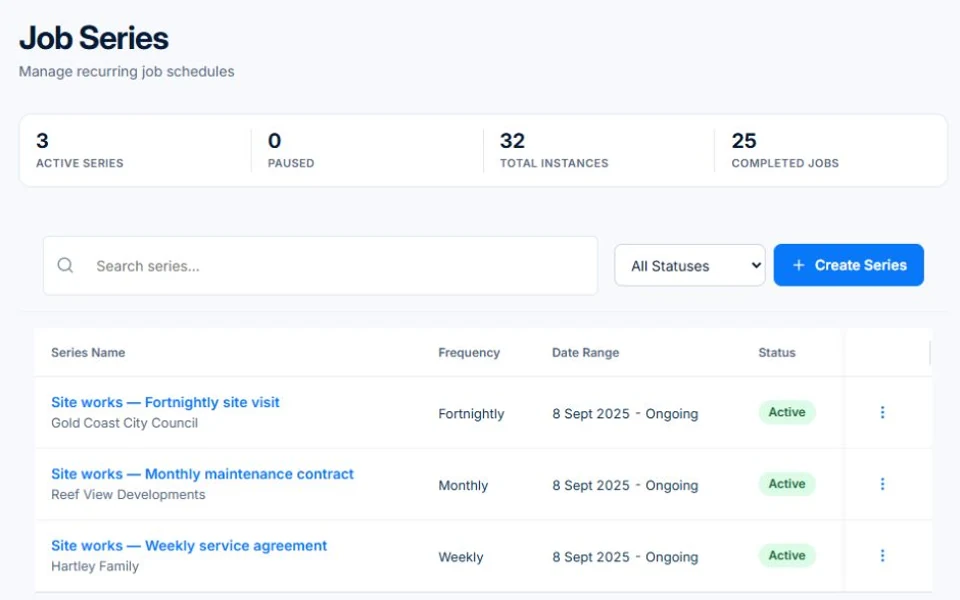
Axiom Blue has recurring job series and recurring invoice templates. Review each setup separately and test how it fits the agreement. Do not assume that creating one automatically creates, combines or stops the other.
Use a sample customer to check an ordinary cycle and a changed visit. Inspect the generated records, timing and customer-facing document before applying the arrangement broadly. Review the first live cycle to confirm it matches the intended work and billing process.
Put it to work
Your practical checklist
- Name the service schedule and the billing schedule.
- Record the agreed charging basis.
- Test a skipped or rescheduled visit.
- Check previous billing before sending the next invoice.
- Review both schedules when the service changes.
See the records in Axiom Blue
Try the workflow with a familiar job.
Features and usage limits vary by plan. Review the tools relevant to your process before choosing your setup.