Equip the Business Right
Cleaning Business Supplies List: What You Need to Start and Run
The right supplies make every job faster, safer, and more professional. The wrong ones, or running out mid-job, cost you time, reputation, and sometimes the client. Here's the complete supplies list for starting and scaling a cleaning business in Australia, with AUD cost guides and how AxiomBlue tracks consumable costs for accurate job margins.
Quick answerA cleaning business starter kit costs roughly $300–$600 AUD: multi-surface, bathroom, glass and floor cleaners, colour-coded microfibre cloths, mop and bucket, scrubbing pads, gloves and a caddy, plus a commercial-grade vacuum ($300–$800). Fully equipping each crew member runs $1,000–$2,500. Track consumable costs per job (AxiomBlue's price book does) to know true margins.
Running out of microfibre cloths at the third property of the day, discovering the vacuum has a cracked filter, or showing up without a glass cleaner because the last bottle wasn't restocked. These are the small operational failures that undermine an otherwise professional service. Supplies management is unglamorous, but it's foundational.
This guide covers everything a cleaning business needs: the starter kit to launch on day one, the professional add-ons that pay for themselves as you grow, eco-friendly alternatives that command a premium, and the maintenance habits that extend the life of your equipment. It also covers how AxiomBlue's price book and job costing tools connect your consumable spend directly to your job margins, so you know what you're keeping as well as what you're earning.
- Complete starter kit with AUD cost estimates: everything needed from day one
- Professional add-ons: steam mop, upholstery tool, tile grout brush, pressure sprayer
- Eco-friendly alternatives and how to offer them as a paid upgrade
- Equipment maintenance schedules that protect your investment
- How AxiomBlue tracks consumable costs per job for accurate margin reporting
What supplies do you need to start a cleaning business?
To start, you need a chemicals kit (multi-surface, bathroom, glass and floor cleaners), colour-coded microfibre cloths, a mop and bucket, a commercial-grade vacuum, gloves, and a caddy — roughly $300–$600 AUD all up. Here's the full breakdown by category, with professional add-ons for later. Prices are typical Australian retail ranges as at mid-2026; check current prices before budgeting.
Starter Chemicals Kit
Multi-surface spray ($8–$15/L concentrate), bathroom cleaner with disinfectant ($10–$18/L), glass and mirror cleaner ($6–$12), cream cleanser for stubborn marks ($5–$9), floor cleaner suitable for timber and tiles ($8–$14/L), and toilet bowl cleaner ($4–$8). Total chemicals outlay for a starter kit: approximately $60–$100.
Cloths, Mops & Buckets
Microfibre cloths: buy in colour-coded sets of 10–15 to prevent cross-contamination ($30–$60 for a quality set). Flat microfibre mop with replaceable pads ($40–$80). Standard mop and bucket for heavy floors ($25–$50). Scrubbing pads in fine and medium grit ($10–$20 for a pack). Rubber gloves: at least two pairs per crew member ($5–$15 per pair).
Vacuum Cleaners
A quality upright or backpack vacuum is your most important investment. Backpack vac ($300–$800): faster on stairs and tight spaces, preferred by professional crews. Upright with HEPA filter ($200–$600): better for pet hair on carpets. Handheld for car detailing and furniture ($50–$150). Budget one vacuum per crew member. Cheap vacuums fail fast. Buy commercial-grade from day one.
Professional Add-Ons
Steam mop ($150–$400): sanitises without chemicals, excellent for tile grout and bathroom floors, increasingly requested by eco-conscious clients. Upholstery cleaning tool ($50–$150): for sofas and fabric chairs when offered as an extra. Tile grout brush set ($15–$30). Pressure sprayer / pump-up sprayer ($30–$80) for pre-treating surfaces. Telescopic duster ($20–$50) for ceiling fans and high surfaces.
Eco-Friendly Alternatives
Koh Universal Cleaner concentrate ($40–$60 per litre, very high dilution): replaces most general-purpose sprays. Seventh Generation or Method bathroom cleaner ($8–$14): plant-derived surfactants, no harsh fumes. White vinegar solution for glass ($3–$5 per litre diluted): streak-free and residue-free. Baking soda for sink and grout scrubbing ($2–$5). Offer eco cleans as a premium line item in your AxiomBlue price book: many clients will pay $10–$30 extra per visit.
Organisation & Transport
Cleaning caddy per crew member ($20–$40): keeps products organised and portable. Apron with pockets ($15–$30): reduces back-and-forth to the caddy. Colour-coded microfibre bag system for dirty cloths ($10–$20). Vehicle organisation: a purpose-built cleaning van rack or tote system ($50–$200) pays for itself in time saved unloading and reloading. Spare rubbish bags for clients' bins ($5–$10 for a roll).
Tracking Supplies Manually vs With AxiomBlue
Most cleaning businesses either ignore consumable costs entirely or try to track them in a spreadsheet. Neither approach connects supply costs to individual jobs, which means you never know your true margin. Here's what the two approaches look like in practice.
| Manual Tracking | AxiomBlue Price Book & Job CostingBuilt for cleaning businesses | |
|---|---|---|
| Consumable cost tracking | Estimated monthly spend, not per job | ✓ Cost price set per item in price book and tracked per job |
| Job margin visibility | Revenue only; materials cost unknown per job | ✓ Job costing report shows labour + materials + travel vs revenue |
| Eco-friendly upsell pricing | Charged inconsistently or forgotten | ✓ Eco clean listed as a price book line item added to quotes |
| Equipment maintenance records | In someone's head or not tracked | ✓ Equipment assets logged with service history notes in AxiomBlue |
| Consumable restocking triggers | Noticed when you run out mid-job | ✓ Usage tracked per job, so you can order before you run out |
| Quoting accuracy | Materials cost guessed or excluded from quotes | ✓ Consumables added as job line items, so quoted cost equals actual cost |
How AxiomBlue Connects Supplies to Job Profitability
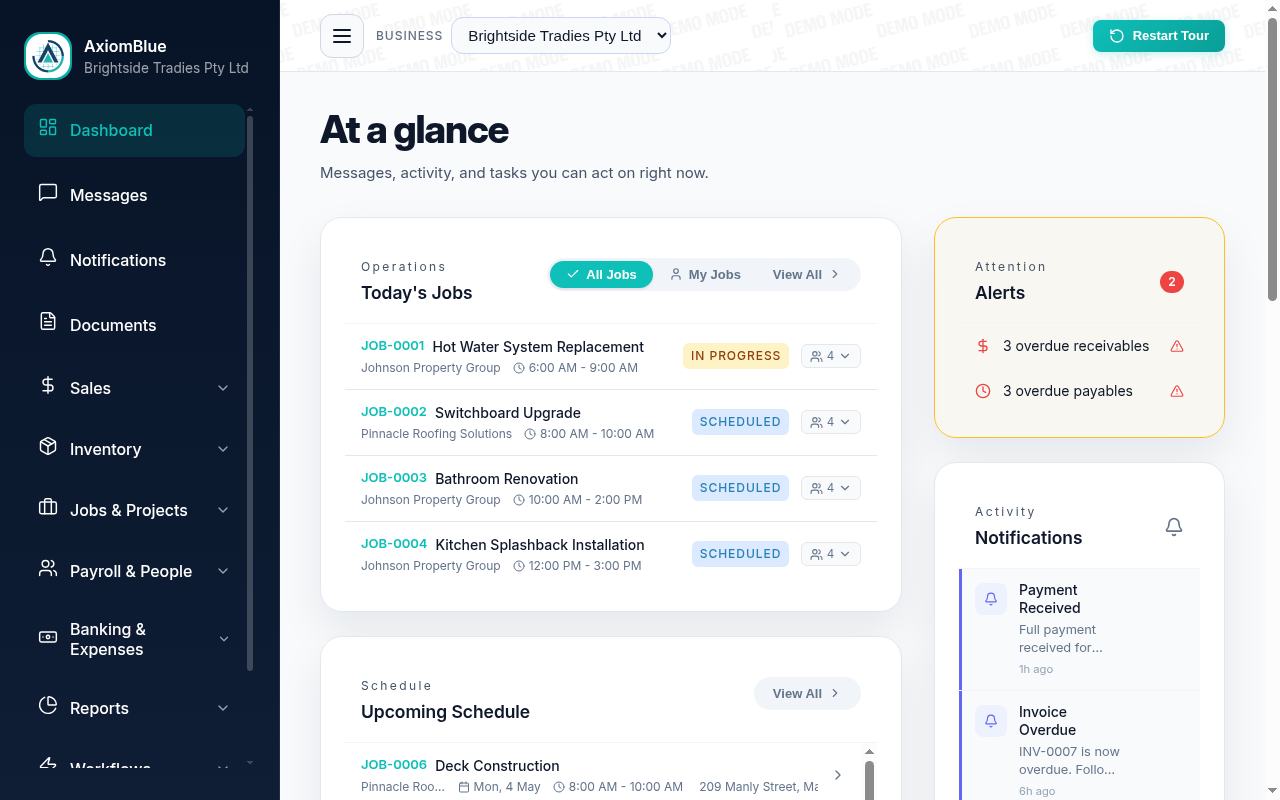
AxiomBlue connects supplies to profitability through its price book and job costing: every consumable carries a cost price, every job records what was used, and the margin per clean falls out automatically. That replaces the common alternative — pricing on gut feel and tracking revenue without ever knowing the real margin per job.
Price Book for Every Supply
Every cleaning product, consumable, and service is stored in the AxiomBlue price book with a sell price and a cost price. When you build a quote, line items pull from the price book automatically, so every quote reflects accurate costs and consistent pricing, regardless of which crew member prepares it.
Job Costing per Clean
When consumables are added to a job as line items, AxiomBlue captures both what you charged the client and what those materials cost you. The job costing report shows gross margin per job (labour, materials, and travel combined) so you can see which service types and clients are actually profitable, not just busy.
Eco-Friendly Upsells
Store your eco-friendly cleaning service as a separate price book item at a premium price. When quoting a client who requests eco products, add it as a line item: the client sees the charge, you see the margin, and your revenue report separates standard and premium service revenue automatically.
Equipment Asset Records
Log each vacuum, steam mop, and piece of equipment as an asset in AxiomBlue. Record purchase date, cost, assigned crew member, and service notes. When a vacuum goes in for servicing, note it on the asset record so you have a maintenance history, which is useful for warranty claims and replacement planning.
Margin Reports by Service
AxiomBlue's financial reports break down revenue and margin by service type: standard clean, deep clean, end-of-lease, eco clean. This reveals which services have the best margin after materials and labour, so you can price competitively where you need to and confidently on the services where your costs are well controlled.
Consumables on the Invoice
When consumable line items are added to a job, they appear on the invoice automatically. Clients see a transparent breakdown of what they're paying for, and the job record keeps a clean history showing that materials costs were disclosed upfront in the quote and invoiced consistently on completion.
How do you maintain cleaning equipment so it lasts?
Professional cleaning equipment lasts five to ten years with basic, habitual maintenance: filters cleaned every few jobs, cloths laundered properly, and machines descaled on schedule. A $600 backpack vacuum that fails at 18 months because the filter was never cleaned is a false economy, and the maintenance has to be habitual, not reactive. Vacuum filters should be checked and cleaned after every three to five jobs. Microfibre cloths lose their effectiveness if washed with fabric softener or dried on high heat. Commercial laundering in hot water with no softener keeps them performing for 200+ washes. Steam mop water tanks need descaling every 30 to 50 uses with a white vinegar flush, especially in hard-water areas like Perth and Adelaide. Build these checks into your end-of-day routine, and equipment longevity largely takes care of itself.
The harder discipline is tracking maintenance across multiple crew members and multiple pieces of equipment. When there are three vacuums shared across a crew, it's easy for no one to feel responsible for any of them. In AxiomBlue, each piece of equipment can be logged as a named asset and assigned to a crew member, with notes added when maintenance is performed. This creates a simple maintenance log without the overhead of a separate spreadsheet, and when something fails, you have a history showing whether it was maintained or neglected, which matters for warranty claims and insurance purposes.
Consumable restocking deserves the same discipline. Running out of glass cleaner or disinfectant mid-job is unprofessional and rattles client confidence. A practical system: each crew member checks their caddy at the end of each shift and flags low items in AxiomBlue's job notes. The office sees the flag and restocks before the next day's schedule. More sophisticated operations set a minimum par level for each consumable and order when usage tracked through AxiomBlue's job costing data shows quantities are dropping toward the reorder point. Either way, the goal is the same: your crew shows up to every job fully equipped, every time.
Frequently Asked Questions
To start a residential cleaning business, you need: a multi-surface cleaner, bathroom cleaner, glass cleaner, disinfectant, microfibre cloths (at least 10–15 in different colours for cross-contamination control), a mop and bucket, a vacuum cleaner, scrubbing pads, rubber gloves, and a caddy to carry it all. Budget around $300–$600 AUD for a solid starter kit. You can scale up to professional equipment like a steam mop, upholstery tool, and pressure sprayer as your client roster grows.
A basic starter kit runs $300–$600 AUD covering chemicals, cloths, mop, bucket, and a vacuum. Adding a quality upright or backpack vacuum ($300–$800), a steam mop ($150–$400), and a stocked caddy for each crew member adds another $500–$1,500 per person. Professional commercial equipment like a wet/dry vacuum or rotary floor machine can cost $800–$3,000. Most cleaning businesses spend $1,000–$2,500 per crew member when fully equipped for residential cleaning.
Supplying your own products is more professional, ensures consistency, and protects you from liability if a client's product damages a surface. It also lets you cost consumables into your pricing. In AxiomBlue's price book, you can include consumables as a line item cost on each job, so your quote reflects the actual cost of materials, and your job costing report shows the true margin after labour, travel, and supplies.
Popular eco-friendly options for Australian cleaning businesses include Koh Universal Cleaner, Seventh Generation multi-surface spray, Method bathroom cleaner, and white vinegar-based glass cleaners. Eco products typically cost 20–40% more per litre, but many clients, particularly families with young children or pets, actively request them and are willing to pay a premium. Consider offering 'eco clean' as a paid upgrade in your price book with a small surcharge to cover the higher product cost.
In AxiomBlue, consumables are stored in the price book with a cost price. When they're added to a job as a line item, the cost is captured against that job. At the end of the week or month, your job costing report shows exactly how much was spent on materials per job, per client, or across the whole business, and what margin you made after those costs. This is the difference between knowing your revenue and knowing your profit.
Vacuum filters need cleaning every 3–5 jobs, steam mop descaling every 30–50 uses, and microfibre cloths commercial laundering after each shift to maintain efficacy. Equipment like vacuums, steam mops, and pressure sprayers should be serviced annually. In AxiomBlue, equipment can be recorded as assets with service notes attached, so you have a maintenance log for each piece and can track when items are due for servicing or replacement.
Know the Cost of Every Job, Not Just the Revenue
AxiomBlue's price book tracks every consumable against every job so your margin reports reflect reality, not guesswork. Start your free plan with no time limit and run your first job cost report today.
No credit card required • Free plan, no time limit • Cancel anytime