Landscaping Business Income & Pricing
How Much Do Landscapers Make?
Income varies widely in landscaping. A solo mowing run earns very differently from a multi-crew operation. Here's what separates the most profitable landscaping businesses from the ones that stay busy but underpaid.
Quick answerHow much landscapers make in Australia depends less on effort than on pricing, cost tracking, and job mix. The highest-earning owners know their real cost per hour, price in materials markup and overhead, convert one-off clients into recurring maintenance contracts, and invoice every variation. Job-costing software like AxiomBlue shows actual versus quoted hours, so underpriced work gets repriced.
Two landscaping businesses can be the same size, serve the same area, and charge similar rates. One owner earns twice what the other does. The difference almost never comes down to how hard they work or how good the landscaping is. It comes down to how they price, how they track costs, and whether the business has the systems to run efficiently at scale.
The common pattern in landscaping businesses that struggle with income: they charge by feel, don't track how long jobs actually take, absorb scope changes without invoicing, and don't know which job types are actually profitable. The businesses with strong income know their real cost per hour, price to include materials markup and overhead, convert one-off clients to recurring maintenance contracts, and have every variation quoted and approved before work changes. AxiomBlue gives you the job costing visibility to know whether your pricing is covering your actual costs. And the tools to do something about it when it isn't.
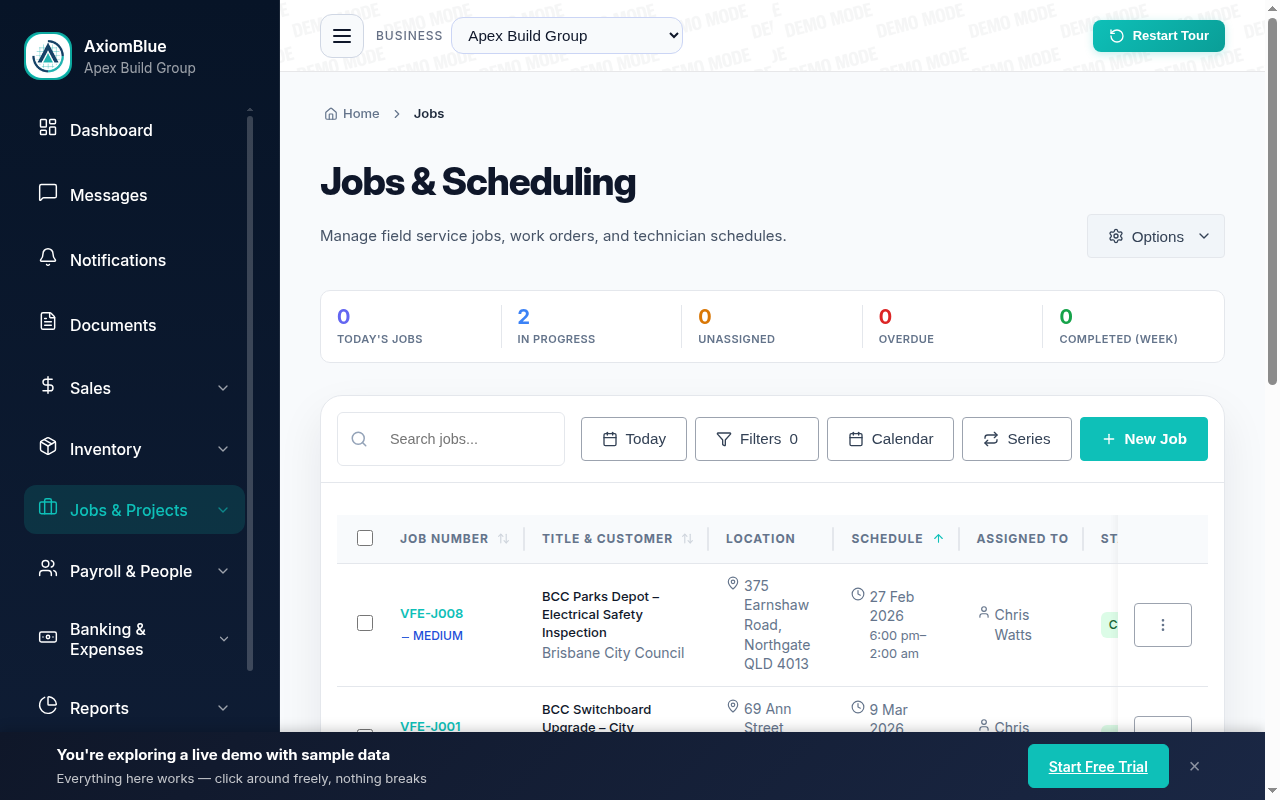
- Actual vs quoted hours tracked per job: see where time goes over
- Materials cost tracking: actual spend vs quoted budget in real time
- Variation management: every scope change quoted and invoiced
- Recurring maintenance setup: predictable income with low admin overhead
- Per-job profitability reporting: know which work types make money
What do high-earning landscaping businesses do differently?
The income gap in landscaping isn't about the work itself. It's about three operational habits that compound over every job.
Pricing to the Real Cost
Most undercharging in landscaping happens in quoting: estimating by feel rather than by calculating actual labour hours, materials, equipment time, and overhead. Businesses that quote based on real costs consistently earn more per job without working more hours.
Converting One-Off to Recurring
Recurring maintenance contracts generate the same revenue as equivalent one-off jobs but with far less quoting, admin, and scheduling overhead. Every one-off client who converts to a weekly or fortnightly maintenance contract improves the business's income per hour of work.
Knowing Which Jobs Are Profitable
Not all landscaping work earns the same. Design projects with complex plant procurement can run over budget in ways that eat the margin. Some maintenance routes are inefficient. Knowing the real profit on each job type lets you price better and decline the work that doesn't pay.
Hourly-rate businesses vs. value-priced businesses
The method you use to price landscaping work affects income more than how hard you work or how much you charge per hour.
| Hourly rate pricing | Job-based pricing Higher income per day | |
|---|---|---|
| Income ceiling | Capped at hours you can bill | ✓ Efficient crews earn more per hour of their time |
| Materials margin | Often billed at cost. No margin. | ✓ Materials included in job price with markup |
| Scope changes | Awkward to add hours mid-job | ✓ Variation quoted and approved before work changes |
| Client perception | Clock-watching, tracking hours | ✓ Fixed price, no surprises. More trust. |
| Recurring maintenance | Time-consuming to schedule weekly | ✓ Fixed contract. Easy to predict and schedule. |
| Profitability visibility | Hard to see which jobs pay well | ✓ Actual vs quoted tracked per job |
Tools that help landscaping businesses see and improve their real income
Knowing your hourly rate isn't enough. These are the specific AxiomBlue features that show whether that rate translates into actual income after real costs.
What Determines Landscaper Income
Service type (maintenance vs construction vs design), geographic market, utilisation rate, and, most importantly, how accurately you price. A mowing run priced correctly earns more per hour than a construction job priced by gut feel. The income ceiling for any landscaper is determined by how well their pricing covers their real costs. Everything else is a multiplier.
Price Book for Consistent Margins
The fastest way to raise what you earn per job is to build a price book with realistic markup applied to every item. AxiomBlue's price book stores each item's description, unit price, tax code, and your selling price. When you build a quote from the price book, the margin is built in automatically. No mental maths, no forgetting to include a cost. Two quotes built by different people from the same price book produce the same margin. Consistency is the foundation of predictable income.
Actual vs Quoted Tracking Per Job
AxiomBlue shows actual labour hours versus quoted and actual materials versus quoted budget on every completed job. If your lawn renovation quotes assume 5 hours and jobs consistently run 7, you'll see it in the data across 10 jobs, not just a vague feeling that something is wrong. This is how you identify which job types are systematically underpriced and adjust before the pattern compounds over another season. Data-driven pricing, not gut feel.
Job Series + Recurring Invoice Templates
Maintenance programs are the most reliable income lever in landscaping. Set up each maintenance client as a job series: weekly or fortnightly frequency, crew assigned, scope recorded. Jobs auto-create in the calendar each period. Configure a recurring invoice template and AxiomBlue generates and sends the invoice automatically at the end of each period. A recurring mowing contract at $250/visit, 5 visits/fortnight = $2,500/month in revenue that arrives without re-booking, re-quoting, or manual invoicing.
Automated Payment Reminder Schedule
Earned revenue only becomes income when it's collected. In AxiomBlue, configure your payment reminder schedule once: 3 days before due, on due date, 7 days after, 14 days after. The automation fires for every overdue invoice without you thinking about it. Check the aged receivables dashboard weekly. It shows outstanding invoices grouped by age (current, 1–30, 31–60, 61–90, 90+ days) so you can see at a glance whether your cash position reflects your revenue position.
Commercial Projects: Section Grouping + Progress Billing
Commercial landscaping projects tend to have better gross margins but more complexity. AxiomBlue's room/section grouping lets you group quote line items by project phase or area. Commercial clients see a clear breakdown of what they're paying for at each stage. For large projects, use progress invoices: deposit on signing, milestone on material delivery, balance on completion. All three link to the same job. No double-billing, clear payment history for both parties.
How do you find out which landscaping jobs are actually profitable?
A landscaping business owner runs 40 jobs a month. They're busy. The phone rings constantly. They feel like they should be making more money than their bank account shows.
The problem isn't the rate they charge. It's that they don't know which jobs are making money and which aren't. Every job feels roughly the same.
In AxiomBlue, after three months of tracking actuals, the picture is specific. Lawn renovations are running 35% over on labour consistently: the estimate assumes 5 hours but the average actual is 6.75 hours. Native garden installations run over on materials because plant procurement is unpredictable without a pre-priced species assembly.
Maintenance visits are exactly on target because the price book handles them systematically. The data doesn't show a vague feeling that something is off. It shows exactly which job types need repricing and by how much.
The fix is straightforward once the data is visible. For lawn renovations: rebuild the price book estimate to 7 hours, not 5. For native gardens: add an assembly with a realistic per-plant contingency based on actual procurement history.
Three months after those changes, the same volume of work produces measurably better income. The business isn't working harder. It's pricing more accurately. That's the difference between a landscaping business that grows and one that stays busy at the same income level indefinitely.
Landscaper Income: Common Questions
Landscaping hourly rates in Australia typically range from $50 to $120 per hour depending on the type of work, the operator's experience, and the market. Basic maintenance work like mowing and edging sits at the lower end. Skilled design and construction work, or businesses in high-demand urban areas, typically charge at the higher end. Most profitable landscaping businesses charge by job rather than by the hour.
A landscaping business owner's income depends heavily on the size of the business, the service mix, and how efficiently operations are managed. A solo operator working full-time can earn between $60,000 and $120,000 depending on rate and utilisation. A business owner managing a team of 4–6 who has extracted themselves from day-to-day labour can earn significantly more. But only if the business has strong margins and systems to run without their constant presence.
Recurring maintenance contracts are typically the most profitable work for landscaping businesses because the labour is predictable, the route is optimised, and the administrative cost per dollar of revenue is low. Design-and-construct projects can have higher gross margins but take more management, carry more material cost risk, and have significant quoting overhead that must be covered by the margin.
The most common ways landscapers leave money on the table: quoting by feel rather than by actual cost calculation, not tracking actual labour hours against quoted hours, not logging materials used against the quoted budget, and not charging for variations when scope changes mid-job. Each of these gaps individually might seem small. Together, they can mean working for well below the real cost of running the business.
The main levers that don't require price increases: route optimisation (less drive time, more billable hours per day), converting one-off clients to recurring maintenance contracts (lower administration cost per job), reducing materials waste by tracking actual usage, and making sure every variation and additional scope item is quoted and invoiced rather than absorbed as goodwill.
AxiomBlue tracks actual labour hours versus quoted hours and actual materials cost versus quoted budget, job by job. Over time, you can see which job types are consistently over their quoted cost. Adjust your pricing accordingly. The variation management tool means scope changes get quoted and invoiced rather than absorbed. Recurring job automation reduces the administrative overhead of maintenance contracts.
Know What Your Jobs Actually Cost. Price Accordingly.
AxiomBlue tracks actual labour and materials against every quote so you can see your real margins job by job. Stop working for less than it costs to run the business.
No credit card required • 14-day free trial • Cancel anytime