FREE MONEY FOR SMALL BUSINESS
Grants for Starting a Lawn Care Business in Australia
Government grants, tax write-offs, training subsidies, and startup support programs: an honest guide to what is available to Australians starting a lawn care business, where to find it, and what to invest in once you have it.
Quick answerNo Australian grant program exists specifically for starting a lawn care business, but genuine support does: a fortnightly income allowance while you establish the business, tax deductions like the instant asset write-off on mowers and equipment, subsidised training for industry qualifications, and state-based small business grants that cover trade service businesses.
Let's be honest up front: there is no grants programme in Australia that exists specifically to fund someone buying a mower and starting a lawn care round. But that doesn't mean you are on your own financially. Several federal and state programs apply to lawn care startups, including a fortnightly income allowance while you build the business, tax deductions that can offset the cost of your equipment, subsidised training for industry qualifications, and state-based small business grants that do apply to trade service businesses.
The key to navigating government support is knowing which programs you are actually eligible for, checking the current status of those programs (they open and close, and thresholds change), and not wasting six months applying for something that closed two years ago. This guide covers the real options (what they offer, who can access them, and where to apply) along with an honest note on the limitations of each.
- New Business Assistance with NEIS: income support while you start out
- ATO instant asset write-off: immediate tax deduction on equipment
- State small business grants: varies by state and time of year
- Subsidised training: horticulture and chemical application qualifications
- Service NSW small business support: advisory and grants for NSW operators
- grants.gov.au: the most comprehensive current-grants search tool
What government support can you get to start a lawn care business?
Grant programs vary and change, but these three categories have been consistently available in some form to Australian small business starters in the trades and services sector. Check current eligibility and open status before applying.
New Business Assistance with NEIS
The NBA with NEIS program through Workforce Australia provides eligible job seekers with a fortnightly income allowance (equivalent to Youth Allowance or JobSeeker) and access to a business mentor for up to 52 weeks while they establish a new business. A lawn care business is an eligible business type. You must be registered with an Employment Services Provider and have a viable business plan. This is genuinely useful support for someone transitioning from unemployment or casual work into self-employment. It reduces financial pressure in the critical first year.
ATO Instant Asset Write-Off
The ATO's instant asset write-off provisions allow eligible small businesses to immediately deduct the cost of depreciating assets, including commercial mowers, trailers, spray rigs, line trimmers, and blowers, in the year of purchase rather than depreciating them over several years. The threshold and eligibility criteria have changed multiple times; check the ATO website for current rules. A registered tax agent can help you claim correctly. This doesn't put cash in your pocket immediately, but it can significantly reduce your tax bill in the first year of trading and free up working capital as a result.
State Small Business Grants
Every Australian state and territory has some form of small business grant or support program, but they are not always open, they are often competitive, and eligibility requirements vary. NSW has Service NSW and the Small Business Support Program. Victoria has Business Victoria grants. Queensland has the Small Business Grants program through DITI. Western Australia has the Small Business Development Corporation. These programs open and close with little fanfare. The only reliable approach is checking grants.gov.au and your state's business portal regularly, or signing up to their grant notification mailing lists.
Support Programs at a Glance
Each program covers different needs and comes with different eligibility hurdles. Use this as a starting point, not a substitute for checking the current program status at the official source before you apply.
| Program | What It Provides | Where to Apply Check current availability |
|---|---|---|
| NBA with NEIS (Workforce Australia) | Fortnightly income allowance + business mentoring for up to 52 weeks while starting a new business | workforceaustralia.gov.au, via your Employment Services Provider |
| ATO Instant Asset Write-Off | Immediate tax deduction on eligible depreciating assets (equipment, tools, trailer) up to current threshold | ato.gov.au: claim via your tax return; consult a registered tax agent |
| State Small Business Grants | Cash grants for eligible small businesses; amounts, eligibility, and timing vary significantly by state | grants.gov.au + your state's business portal (Service NSW, Business Victoria, etc.) |
| Subsidised Training (Skills First / equivalent) | Subsidised fees for Certificate III/IV qualifications in horticulture, landscaping, or chemical application | Your state's training authority or local TAFE; check with Skillset RTOs |
| Apprenticeship / Traineeship Incentives | Employer wage subsidies for taking on apprentices or trainees in horticulture qualifications | australianapprenticeships.gov.au: check current incentive rates for your trade |
| ASBFEO Support Services | Advocacy, dispute resolution, and referrals to small business support (not a grant provider) | asbfeo.gov.au, useful for navigating disputes and finding further support resources |
What AxiomBlue Does for a Lawn Care Startup
Grants get you started. The right operational systems keep you in business. AxiomBlue is the platform that makes a lawn care business look and run professionally from the first week of trading, giving clients and commercial prospects the confidence to hire you and stay with you.
Professional Quotes from Day One
Send branded, itemised quotes by email with client e-signature from your first week of trading. Store your standard service rates in the price book so every quote is consistent and correctly priced. Track whether clients have viewed and accepted quotes. No more wondering whether your email landed.
Recurring Job Scheduling
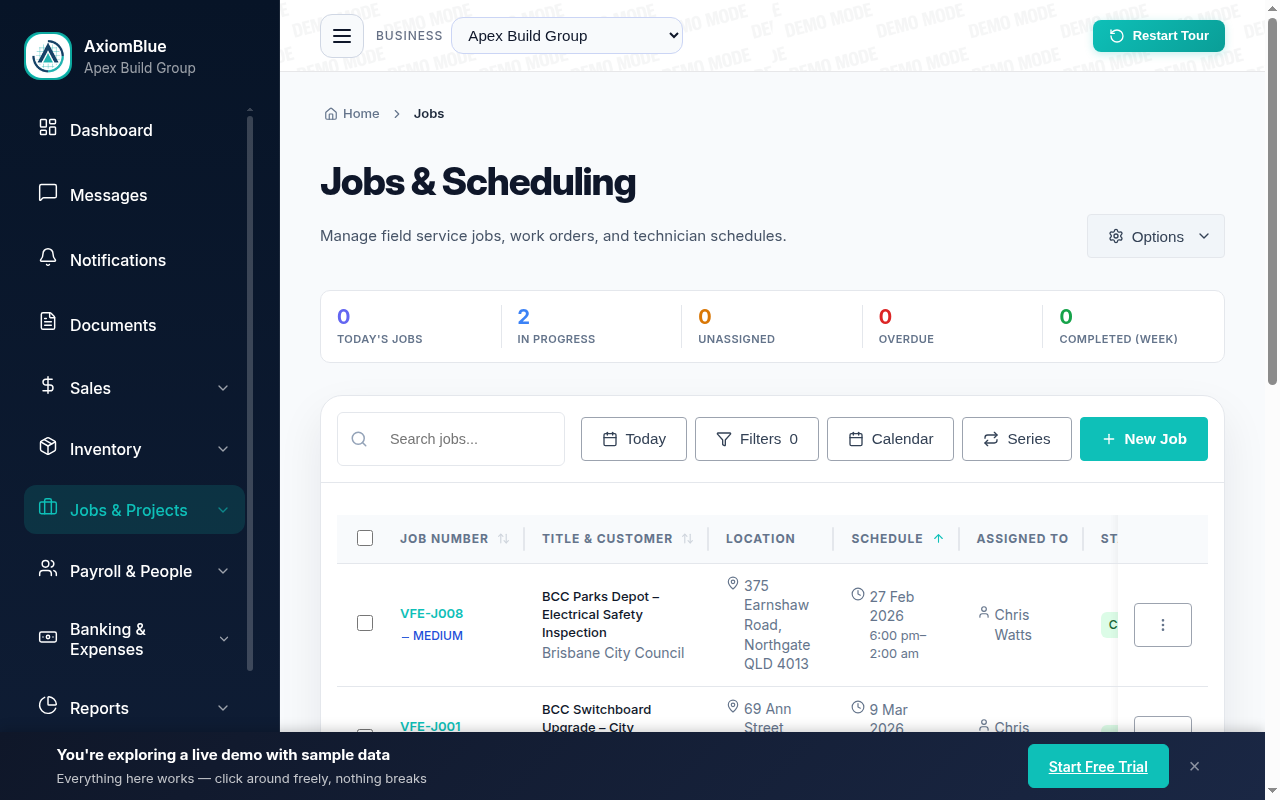
Set up fortnightly or monthly recurring visits for residential clients as soon as they sign up. The calendar shows your full schedule at a glance. As you grow, drag-and-drop scheduling lets you add new clients, adjust routes by suburb, and assign crew without rebuilding your schedule from scratch each week.
CRM to Build Your Client Base
Track every lead from first enquiry to signed recurring client. Log notes from conversations, set follow-up reminders, and run automated email sequences to convert enquiries without chasing them manually. Building your own client pipeline from the start means you are never dependent on a single lead source.
Invoicing and Online Payments
Invoices generate automatically when jobs are marked complete. Recurring billing runs on schedule. Stripe payment links mean clients can pay online from their invoice email, with no bank transfers and no chasing. Automated payment reminders handle overdue accounts without awkward phone calls.
Workflow Automation
Use pre-built automation templates to send job confirmation emails when bookings are created, thank-you messages after first visits, and seasonal service reminders to your client list. Automation does the follow-up work that most small operators forget, and that follow-up is where referrals and upsells come from.
Financial Visibility
See your revenue, job costs, and margins from day one. Know which services are actually profitable and which clients are worth keeping. Financial reports give you the data to set your prices correctly, apply for funding or finance with real numbers, and make decisions based on evidence rather than gut feel.
Where should a lawn care startup invest its money first?
Government grants and tax write-offs can help reduce the capital burden of starting out, but they don't determine whether your business survives the first two years. What determines survival is whether you can win clients and keep them, invoice quickly and get paid, manage your schedule without chaos as you grow, and know your numbers well enough to make good decisions. Those outcomes come from your operational systems, not your startup funding source. A lawn care business that starts with a grant and uses spreadsheets and paper invoices is at far greater risk than one that starts with no grant and uses proper scheduling, invoicing, and CRM software from the beginning.
The good news is that purpose-built business software is no longer expensive. AxiomBlue starts at $29 per seat per month, which is less than most operators spend on fuel in a week. For that, you get quoting, recurring job scheduling, a full CRM, automated invoicing, Stripe payment processing, workflow automation, and financial reporting. That is the complete operational infrastructure that used to require multiple separate tools, a significant setup cost, or a franchise system to access. And because it is designed for Australian field service businesses, it handles the specific workflows of a lawn care operation: recurring clients, crew management, route planning, and job-level costing.
If you are actively applying for grants or going through the NEIS process, good. Use every resource that is legitimately available to you. But don't wait until funding comes through to get your systems right. Set up AxiomBlue on the free 14-day trial before you take your first paying job, so when the clients start coming in you are already operating like an established business rather than figuring out your admin on the fly. The businesses that make it past year two are the ones that looked professional and ran efficiently from the start, regardless of how they funded their equipment.
Lawn Care Business Grants: Questions Answered
There is no single grant exclusively for lawn care businesses, but several programs are accessible to lawn care startups. The NBA with NEIS through Workforce Australia provides a fortnightly income allowance and business mentoring for eligible job seekers. The ATO's instant asset write-off provides immediate tax deductions on eligible equipment. Many states also have small business grants accessible to trade service businesses. Check grants.gov.au and your state's business portal for currently open programs, as they open and close throughout the year.
The New Business Assistance with NEIS (NBA with NEIS) is a Workforce Australia program that provides eligible job seekers with a fortnightly allowance and business mentoring for up to 52 weeks while establishing a new business. A lawn care business is an eligible business type. To qualify, you must be registered with an Employment Services Provider, have a viable business plan, and not be in full-time paid employment. Contact your local Workforce Australia provider to check your eligibility and begin the application process.
Yes. Under the ATO's instant asset write-off provisions, eligible small businesses can immediately deduct the cost of eligible depreciating assets, including commercial mowers, trailers, spray rigs, line trimmers, and blowers, in the year of purchase. The applicable threshold and eligibility rules have changed over time, so check ato.gov.au for the current rules applying to your financial year. A registered tax agent can help you claim correctly and confirm which assets qualify under the current provisions.
The Australian Government's grants finder at grants.gov.au is the most comprehensive starting point. It's searchable by industry, location, and business stage. For state-specific programs, check: Business Victoria (business.vic.gov.au), Service NSW (service.nsw.gov.au/small-business), Business Queensland (business.qld.gov.au), Business SA (business.sa.gov.au), the Small Business Development Corporation in WA (smallbusiness.wa.gov.au), and Business Tasmania. Grant programs open and close regularly, so check these portals every few months or sign up for their grant notification emails.
Yes. Subsidised training is available under state and territory training plans. Horticulture, landscaping, and chemical application certifications may attract subsidised fees under your state's Skills First or equivalent program. The Australian Apprenticeships and Traineeships system provides employer wage subsidies for businesses that take on apprentices or trainees in horticulture qualifications. Check with your state's training authority, local TAFE, or registered training organisations (RTOs) like Skillset for currently subsidised courses in your region.
No. The Australian Small Business and Family Enterprise Ombudsman (ASBFEO) is an advocacy and dispute resolution body, not a grant provider. It does not directly fund businesses. However, ASBFEO is a useful resource for navigating disputes with government agencies, understanding your rights in franchise or commercial lease situations, and accessing referrals to small business support services. Their website (asbfeo.gov.au) aggregates links to government programs that may be relevant to new business owners.
Give Your Lawn Care Business the Right Foundation
Grants reduce your startup costs. The right systems build a sustainable business. AxiomBlue gives a new lawn care operator professional quoting, recurring job scheduling, CRM, automated invoicing, and workflow automation from day one. Pricing starts at $29 per seat per month, with a 14-day free trial and no credit card required.
No credit card required • 14-day free trial • Cancel anytime