Professional · Time Tracking Automation
Can Timesheets Fill Themselves In? Automatic Timesheets with Geofencing
Arriving on site clocks the worker onto the job. Leaving clocks them off. Two ready-made AxiomBlue automation templates turn the site visit itself into the timesheet entry — no taps to remember, no Friday-night reconstruction, and no continuous tracking in between.
Quick answerYes — timesheets can fill themselves in. Geofenced time tracking clocks a worker onto a job when they arrive at the site and off when they leave, using entry and exit as the trigger instead of a tap someone has to remember. AxiomBlue ships this as two automation templates on its Professional plan ($59 AUD per seat per month); the platform starts at $29 AUD with a free plan that has no time limit.
Key facts: geofenced automatic timesheets in AxiomBlue
The checkable essentials before the detail. Everything in this table is expanded further down the page.
| The templates | Auto-Start Timesheet on Job Site Entry · Auto-Close Timesheet on Job Site Exit |
| What triggers them | Site entry and site exit events — not continuous location tracking |
| Plan | Automation is on Professional, $59 AUD per seat/month; platform from $29 (Basic) |
| Free plan | No time limit, no credit card required |
| Apps | Free native iPhone & Android apps + the full platform in any web browser |
| Double-entry guard | Both templates check whether the worker is already on the clock before acting |
| Where hours go | Job costing, the invoice, and a clean export to your payroll system |
| Payroll | AxiomBlue does not run payroll — hours export by employee, job, and date |
Can timesheets fill themselves in?
They can, for the part of the day a timesheet is actually about: when the worker arrived at the job and when they left. Geofenced automatic timesheets use those two moments — site entry and site exit — as automation triggers, so the timesheet entry is created by the visit itself rather than by a tap someone has to remember while carrying a ladder.
AxiomBlue is job management software built in Australia for trade and field-service businesses, and its GPS time tracking already makes clocking on a one-tap job from the phone. The two geofence templates remove even that tap. Arrive at the site of the job you're assigned to, and the Auto-Start template clocks you on. Drive off at the end, and the Auto-Close template clocks you off. The entry lands on the right job automatically, because the whole thing runs against the job whose site you entered.
The honest boundary up front: this automates the arrival and the departure. It reacts to two events and otherwise does nothing — it isn't watching where you are between jobs. Manual clock on and off stays available the whole time, and any entry can be corrected afterwards.
How does the geofence automation run, step by step?
Two templates share the work: one handles arrival, one handles departure. In plain words, here is exactly what each does — no more, no less.
Auto-Start Timesheet on Job Site Entry runs when a worker arrives at their job's site:
- Trigger: a site entry event arrives from the AxiomBlue app on the worker's phone.
- Check the job: has this job been started yet? If not, the automation starts it — so an early arrival doesn't clock time against a job that's still sitting at "scheduled".
- Check the worker: is this person already on the clock? If they are, the automation stops right there. No duplicates.
- Act: clock the worker on and mark their assignment as working. The timesheet entry now exists, attached to the job, stamped with the arrival.
Auto-Close Timesheet on Job Site Exit runs when they leave:
- Trigger: a site exit event fires as the worker leaves the job site.
- Check first: is the worker actually clocked on? If not — say they clocked off manually before leaving — nothing happens.
- Act: clock the worker off and mark the assignment finished. The entry closes at the moment the visit actually ended, not whenever someone remembers.
That check-then-act shape is the whole design. Every action is preceded by a condition that asks whether the action is still needed, which is what makes the automation safe to leave running: it can only ever bring the timesheet into line with what's physically happening on site.
Is geofenced clock-on fair on the crew?
Yes — because the automation is triggered by entering and leaving a job site, and does nothing else. It is not continuous tracking. There is no live breadcrumb trail, no map of where the ute went at lunch, and no record between the exit from one site and the entry to the next. AxiomBlue records the same two moments a manual tap would record; the geofence just supplies the tap.
In practice the crew are usually the first winners, for the same reason they win with proper timesheet software generally: the early start actually gets captured. The 7:42am arrival goes on the clock at 7:42, not rounded to 8 from memory on Friday. Every worker can see their own entries, corrections take seconds, and every correction is kept in the change history on the job record — so the record is honest in both directions.
The right way to roll it out is openly. Tell the team what is recorded (a clock-on when you arrive at your job's site, a clock-off when you leave), what is not (everything in between), and why (so the hours worked are the hours billed and paid). Most objections to GPS in the workplace are objections to surveillance — and an entry/exit trigger that writes the same entry a tap would have written isn't that.
What stops double clock-ons and phantom entries?
Condition checks built into both templates. The Auto-Start template asks "is this worker already clocked on?" before it does anything, and stops if the answer is yes — so a signal blip that re-fires the site entry, or a worker who already tapped on manually, never produces a second open entry. The Auto-Close template only clocks off workers who are actually on the clock, so a drive past the site on the way to the supplier can't close anything that isn't open.
And when something genuinely odd happens — a phone left in the ute, a geofence that clips the neighbour's driveway — the fallback is the same one-tap manual tracking the platform has anyway. The automation is a safety net, not a replacement. Workers and the office can both fix an entry in seconds, and the change history keeps an honest record of every change.
Can I change how the automation works?
Yes — both geofence templates are ordinary workflows in AxiomBlue's visual automation editor, built from the same drag-and-drop trigger, condition, and action nodes as every other template. Open the template and you can see each step on the canvas, adjust it, or extend it: add an in-app notification to the office when a worker clocks on, for example, or a different action path for particular jobs. No code, no scripting.
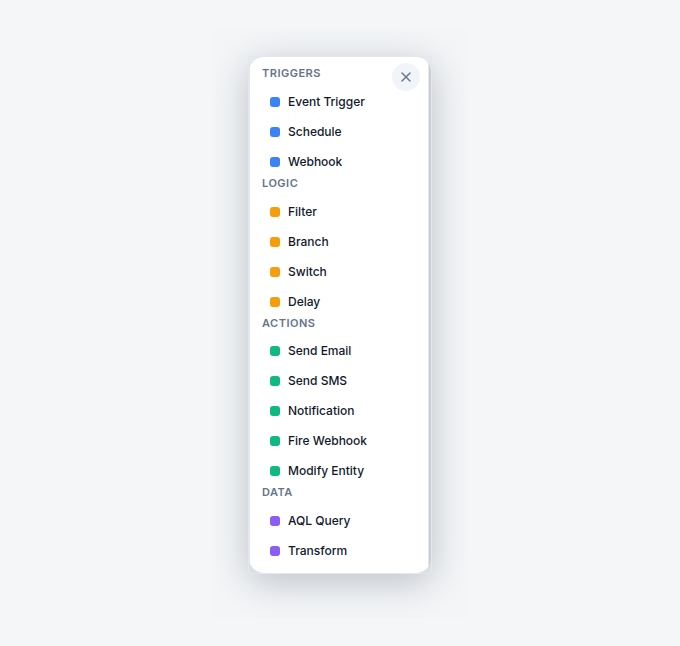
The two timesheet templates are deliberately small — a trigger, a couple of checks, a couple of actions — which is exactly what makes them easy to trust and easy to modify.
How do automatic hours reach my payroll system?
The same way all tracked hours leave AxiomBlue: as a clean timesheet export by employee, job, and date for any pay period, ready to hand to your payroll system. AxiomBlue does not run payroll — no pay rates, awards, or payslips live in it. It fixes the input instead, which is where most payroll pain actually starts.
Geofenced entries make that input better in a specific way: the start and end times are the real arrival and departure, captured by the visit itself. A pay run built from reconstructed hours is wrong before the payroll software ever sees it; one built from entries that opened at arrival and closed at departure starts from the truth. And because every entry is attached to a job, the same hours feed the job's live labour cost and its invoice too. One captured number, three outputs, zero re-keying.
What changes when the timesheet fills itself in?
The forgetting stops. Manual capture — even good one-tap capture — still depends on a human remembering at the two busiest moments of a site visit: arriving with a job to start and leaving with the next one on the clock. Here is the honest three-way comparison.
| Paper / memory timesheets | AxiomBlue geofence automation Entry/exit triggered | Manual clock-on apps | |
|---|---|---|---|
| Who creates the entry | ✗ Someone, later, from memory | ✓ The site visit itself | ~ The worker, if they remember |
| Start/finish accuracy | ✗ Rounded to the nearest hour | ✓ Actual arrival and departure | ✓ Accurate when tapped on time |
| Forgotten clock-offs | ✗ Everything is a forgotten clock-off | ✓ Leaving site closes the entry | ✗ Open entries run overnight |
| Hours tied to the job | ✗ Weekly totals, best guess | ✓ Runs against the job whose site was entered | ~ Depends on tapping the right job |
| Duplicate protection | ✗ None | ✓ Already-clocked-on check before every action | ~ Varies by app |
| Payroll-system input | ✗ Manually tallied | ✓ Clean export by employee, job, date | ~ Export, often not job-linked |
Manual one-tap tracking is already a big step up from paper — AxiomBlue includes it on every plan. The geofence templates close the last gap: the entries nobody made because their hands were full.
What does automatic time tracking cost in Australia?
The two geofence templates are part of AxiomBlue's automation engine, included on the Professional plan at $59 AUD per seat per month. The Basic plan at $29 AUD per seat per month includes manual one-tap GPS time tracking — job-linked, exportable, with change history — without the automation on top. Both start with a free plan that has no time limit, no credit card required.
The way to decide is to measure your own leak. Run one crew on the free plan for a fortnight with the geofence templates on, and compare the captured entries against what the old timesheets would have said — look especially at start times before 8am and the days nobody remembered to clock off. If the automation only recovers a few genuinely-worked hours a week across the crew, it has already paid for the plan difference several times over.
Automatic Timesheets — Common Questions
Yes, for the arrival and departure that bookend every site visit. AxiomBlue's geofence automation clocks a worker onto the job when they arrive on site and off again when they leave, so the timesheet entry is created and closed by the visit itself. Manual one-tap clock on and off stays available on every plan, and any entry can be reviewed and corrected.
No. The automation reacts to two events - arriving at the job site and leaving it - and does nothing in between. It is a trigger, not a tracker: there is no live map of the ute and no breadcrumb trail. AxiomBlue records the clock-on and clock-off the same way a manual tap would, just without the tap.
A built-in condition check. Before clocking anyone on, the Auto-Start template checks whether the worker is already on the clock and stops if they are. The Auto-Close template does the reverse - it only clocks off workers who are actually clocked on - so a repeated site entry or exit never creates a duplicate or phantom entry.
Nothing is lost - the worker clocks on with one tap, exactly as they would without the automation. Geofenced clock-on in AxiomBlue is a safety net over manual time tracking, not a replacement for it, and any entry can be corrected afterwards, with every change kept in the change history on the job record.
No. AxiomBlue captures the hours and exports them - by employee, job, and date for any pay period - to your payroll system, which handles rates, awards, and payslips. What the geofence automation changes is the quality of that input: hours that start and end with the actual site visit, not a Friday-night reconstruction.
The two geofence templates are part of AxiomBlue's automation engine, which is included on the Professional plan at $59 AUD per seat per month. The $29 Basic plan includes manual one-tap GPS time tracking without the automation. There is a free plan with no time limit, and no credit card is required to start.
Yes - free native AxiomBlue apps for iPhone and Android, with clock on and off built in, and the full platform also runs in any phone browser, so nobody is forced to install anything. The site entry and exit events that drive the geofence templates come from the AxiomBlue app on the worker's phone.
Let the Site Do the Clocking
Every forgotten clock-on is an hour that was worked and never recorded. Switch the geofence templates on for one crew, run a fortnight, and count the hours that finally show up.
No credit card required • Free plan, no time limit • Cancel anytime